

Other language versions: 繁體中文 · 日本語
The short version
- Sleep really does have a seasonal pattern. An analysis of 73 million nights of mattress-sensor data found that sleep in the northern hemisphere runs 15–20 minutes longer in winter than in other seasons, and that the difference shrinks the closer you live to the equator.
- Feeling sleepy earlier in autumn and winter is mostly about it getting dark earlier. What the research found is the opposite of what people assume: the less daylight you get, the later your body clock tends to run — so you fall asleep later at night and find mornings harder.
- Cooler nights, on their own, do little to sleep stages; bedding and clothing are what matter. What genuinely breaks sleep up is heat, and humid heat in particular.
- From the autumn equinox to the winter solstice, daylight in Taiwan shortens by about an hour and a half and nightfall arrives about 40 minutes earlier; monthly mean temperature falls by roughly 7–10 degrees from September to December. The swing is far smaller than in high-latitude countries, but it points the same way.
The moment the weather turns, your eyelids start getting heavy right after dinner, and at the weekend you sleep past your usual time. Other people get the reverse: autumn arrives and they are awake at four or five in the morning, unable to drop back off. The question this article answers is whether shorter days and cooler nights actually shift how long and when you sleep, what the research found, and which three things — daytime light, evening lamps, bedroom temperature — are worth adjusting if you live in Taiwan.
1. Seasons really do change sleep length: what 73 million nights show
Two terms first, so the rest reads cleanly:
- Circadian rhythm: the body's built-in roughly 24-hour cycle that decides when you feel sleepy and when you feel alert. Light is its main timekeeper.
- Mid-sleep: the midpoint between falling asleep and waking. Researchers often use it to estimate whether someone's body clock runs early or late.
In 2025, Scott and colleagues at the Sleep Health institute of Flinders University (Australia) published "Variations in sleep duration and timing: Weekday and seasonal variations in sleep are common in an analysis of 73 million nights from an objective sleep tracker" in *Sleep*. The study analysed 116,879 adults (mean age 49) whose sleep was recorded by a sensor placed under the mattress between January 2020 and September 2023Note 1. Three findings stand out:
- People slept 20–35 minutes longer at the weekend, went to bed 30–40 minutes later, and got up 60–80 minutes later.
- Seasonal differences are real: northern-hemisphere winter sleep ran 15–20 minutes longer than other seasons, southern-hemisphere summer sleep ran 15–20 minutes shorter, and the closer to the equator, the smaller the seasonal gap.
- Overall sleep duration edged down between 2020 and 2023 — by just 2.5 minutes.
Bringing that back to the original question: "sleeping more once it cools down" does show up in large-scale data, but the size of it is fifteen or twenty minutes, not an hour or two. Taiwan sits at 22–25°N, closer to the equator than the mostly European and North American sample in the study, so the seasonal difference here should be smaller still than 15–20 minutes.
2. Less daylight pushes the body clock later, not earlier
"Feeling sleepy earlier" and "the body clock moving earlier" are two different things. In 2023, Dunster and colleagues in the Department of Biology at the University of Washington (USA) published "Daytime light exposure is a strong predictor of seasonal variation in sleep and circadian timing of university students" in the *Journal of Pineal Research*. The team followed more than 500 university students in Seattle (47.6°N) across all four seasons, recording sleep and light exposure with wrist-worn devicesNote 2. What they found:
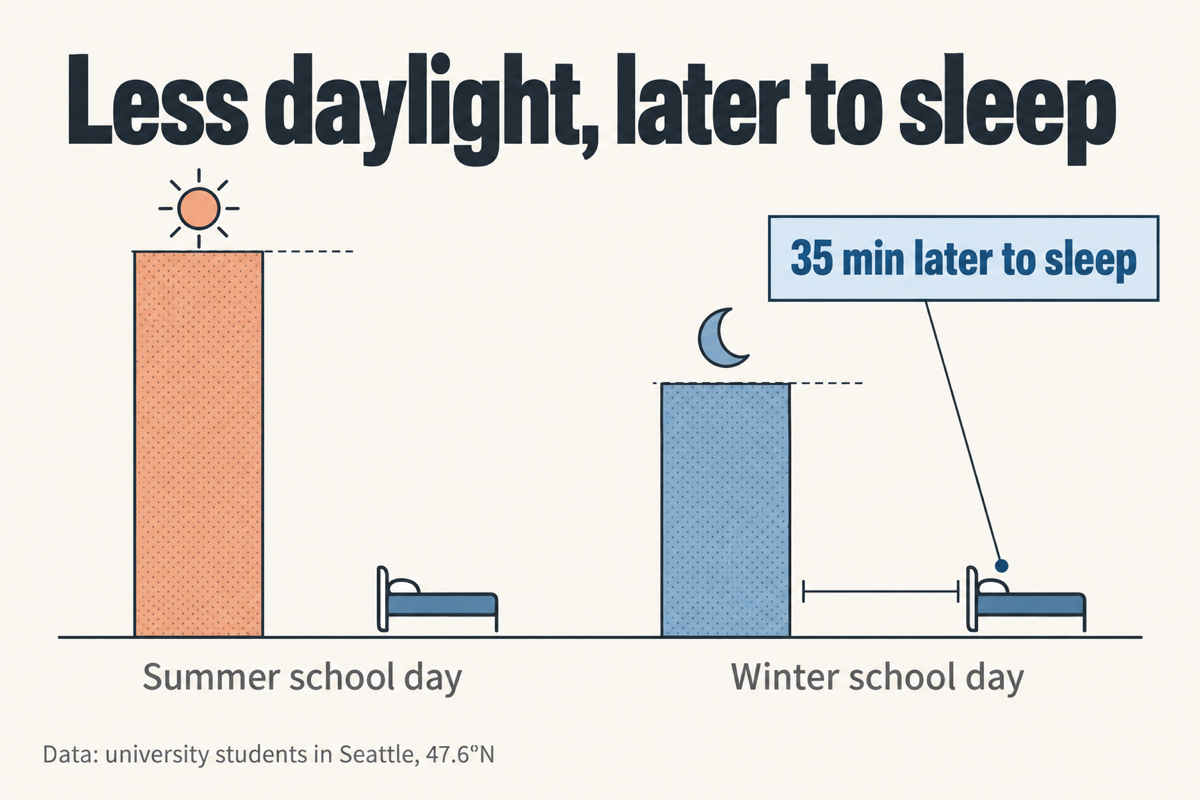
- Even with students keeping the same class timetable, sleep shifted later in autumn and winter. On winter school days they fell asleep 35 minutes later and woke 27 minutes later than on summer school days.
- Body-clock timing estimated from free-day mid-sleep ran more than 30 minutes later in winter than in summer.
- Hours spent in light of at least 50 lux during the day predicted circadian timing better than the same illuminance after sunset. In this observational model, each additional hour of daytime light was associated with a body clock about 30 minutes earlier; each additional hour after sunset was associated with one about 15 minutes later.
The study points the cause of later autumn and winter sleep at not enough daylight. In other words, the early-evening sleepiness you feel in autumn may simply be the dark arriving and the environment dimming; the circadian change that was actually measured runs the other way — later. If autumn and winter find you taking longer to fall asleep and struggling more with mornings, this study is describing you.
As for waking early in autumn: none of the three anchor studies here provide data showing that people wake earlier in autumn. If early waking keeps happening, see the note on when to seek care at the end of this article.
3. Cooler nights: what alters sleep stages is heat, not cold
In 2012, Okamoto-Mizuno and Mizuno at Tohoku Fukushi University (Japan) published "Effects of thermal environment on sleep and circadian rhythm" in the *Journal of Physiological Anthropology* — a narrative review pulling together work on the thermal environment and sleepNote 3. The key points:
| Condition | Effect on sleep |
|---|---|
| Experimental conditions (semi-nude, no bedding) | Cold affects sleep stages more than heat does |
| Real-life conditions (clothing and bedding) | Heat increases wakefulness and reduces deep (slow-wave) sleep and REM sleep |
| Humid heat | Adds further heat load during sleep, affecting both sleep stages and thermoregulation |
| Cold (real-life conditions) | Does not affect sleep stages or subjective experience, but does alter cardiac autonomic response during sleep |
Applied to autumn: even as nights cool, with adequate bedding and clothing the review shows no deterioration in sleep stages. It is the opposite situation — a warm spell, a stuffy room, or a quilt heavy enough to trap heat — that tends to produce light sleep and night-time waking. The authors also note that although cold does not affect sleep stages, it does change cardiovascular autonomic response during sleep, and that this may matter more in real life than heat does. More research is still needed to establish that.
4. What autumn actually looks like in Taiwan: daylight and temperature
The three studies above come from Seattle at 47.6°N, from global data, and from a Japanese laboratory review. How much does autumn in Taiwan actually change? Straight to the numbersNote 4:
| Station | Sunset (21 Sept → 21 Dec) | Daylight length (21 Sept → 21 Dec) | Monthly mean temperature (Sept → Dec) |
|---|---|---|---|
| Taipei | 17:52 → 17:09 | 12.2 hours → 10.6 hours | 27.7°C → 18.2°C |
| Taichung | 17:55 → 17:15 | 12.2 hours → 10.7 hours | 27.8°C → 18.7°C |
| Kaohsiung | 17:57 → 17:19 | 12.2 hours → 10.8 hours | 28.5°C → 21.2°C |
Three conclusions:
- From the autumn equinox to the winter solstice, daylight in Taiwan shortens by only about an hour and a half and nightfall comes about 40 minutes earlier — roughly half the swing Seattle sees over the same period, but in the same direction: less daylight.
- For most people working or studying, autumn and winter mean it is already dark by the time they leave the office or campus, so the only real daylight left is the commute and the lunch break. That is exactly the variable Dunster et al. (2023) identified as decisive.
- Temperature drops from 28 degrees in September to 18–21 degrees in December. Per the review in section three, what disturbs sleep is heat and humid heat; cold on its own does not affect sleep stages. But southern Taiwan is still at 21 degrees in December, where a heavy quilt may instead trap heat.
5. Three things you can do: daytime light, evening lamps, bedtime warmth
Getting more daylight is worth more than cutting evening light
The figure from Dunster et al. (2023) is direct: each additional hour of daylight at 50 lux or more was associated with a body clock about 30 minutes earlier. In practice:
- On the morning commute, walk the outdoor stretch rather than taking underground passages or arcades the whole way. Even on an overcast day, outdoor brightness is far above indoor levels.
- Spend 15–20 minutes of the lunch break outdoors or by a window.
- If you work from home during the day, move your desk to the window, or switch every light in the room on.
Dim the lights after dark, but don't overthink it
Each additional hour of light after sunset was associated with a body clock about 15 minutes later — half the size of the daytime figure. Swapping the living-room ceiling light for a lamp, and avoiding bright overhead light in the hour before bed, is enough. For the evidence on phones and blue-light glasses, see our earlier article Do Blue-Light Glasses, Weighted Blankets and White Noise Actually Help You Sleep? What the Research Says.
The bedroom: keep it from getting stuffy
Per Okamoto-Mizuno and Mizuno (2012), with bedding in place it is heat and humid heat that disturb sleep; cold on its own does not affect sleep stages. A sensible order for changing over your bedding in autumn:
- Switch to a lighter quilt first. On a warm night, go thinner and add long sleeves instead.
- When the room is humid, a dehumidifier matters more than a heater.
- Wait until northern Taiwan is genuinely below 18 degrees in December before bringing out the heavy quilt.
Warmth before bed: footbath temperature and timing
Once the weather cools, a lot of people soak their feet before bed. We already have an article on this — How Warm Is a 41°C Footbath? Water Temp, Timing & a 10-Minute Pre-Sleep Ritual — covering the research on water temperature, duration and sleep. If you want a footbath in your wind-down routine, follow that article: water at about 40–41°C, 10–20 minutes, then dry off and keep warm, with unscented hot-spring powder or nothing added at all. None of the three studies cited here measured foot or full-body bathing. A footbath's role in a bedtime routine is warmth and ritual; it adjusts how your body feels before sleep, and this article does not claim it can shift your circadian rhythm or treat insomnia.
When to see a doctor
See a clinician — start with family medicine or a sleep clinic — in any of these situations:
- Difficulty falling asleep, early waking, or broken sleep on at least three nights a week for three months or more.
- Markedly low mood every autumn and winter, loss of interest in things, and large changes in appetite and sleep, lifting only in spring.
- Daytime sleepiness severe enough to affect driving or work, or accompanied by snoring or pauses in breathing.
- Taking medication that affects sleep, or living with a chronic condition such as thyroid or cardiovascular disease — discuss any change to your schedule with your doctor first.
Frequently asked questions
Is it normal to feel sleepier in autumn?
Large-scale data show northern-hemisphere winter sleep averaging 15–20 minutes longer, so it is a common pattern. But if you are sleeping more and still tired through the day for more than a few weeks, get it assessed.
Why do I take longer to fall asleep in autumn, not less?
That is precisely the direction Dunster et al. (2023) found: less daytime light, body clock pushed later, winter sleep onset 35 minutes later than in summer. Getting more daylight is the measure most clearly associated with an earlier body clock in that research.
Should I run a heater overnight as it gets colder?
Per the thermal-environment review, with bedding and clothing in place cold has almost no effect on sleep stages — stuffy heat and humid heat do. For most of Taiwan, deal with humidity and quilt thickness first in autumn; in the north, reconsider from December depending on how it feels.
Does a footbath before bed help me fall asleep?
None of the three studies cited here measured footbaths. The research on footbaths and sleep is collected in our 41°C footbath article; follow its water-temperature and timing guidance.
Notes
- Sample boundaries in Scott et al. (2025). About 77% of the 116,879 participants were men (90,333 men, 26,546 women), and the sample is drawn from people able to buy a mattress sensor, so the seasonal figures should not be applied directly to everyone.
- Sample boundaries and time convention in Dunster et al. (2023). Single city, high latitude, university students — the numbers do not transfer directly to Taiwan. The "35 minutes later to sleep, 27 minutes later awake" figures are on the original study's daylight-saving time convention. The study is observational in design: it shows association, not intervention effect.
- What a narrative review is. The authors assemble the literature without the fixed search and screening procedure of a systematic review; the work collected here is mostly small-sample laboratory research.
- Sunrise, sunset and daylight length are from the Central Weather Administration's 2026 daily astronomical data (retrieved 2026-09-21); monthly mean temperatures are the CWA 1991–2020 climate normals. Over the same period, daylight on the winter solstice runs about 8 hours 25 minutes in Seattle and about 10 hours 35 minutes in Taipei.
Further reading
- How Warm Is a 41°C Footbath? Water Temp, Timing & a 10-Minute Pre-Sleep Ritual
- Do Blue-Light Glasses, Weighted Blankets and White Noise Actually Help You Sleep? What the Research Says
- You Slept In All Weekend — So Why Are You Still Tired on Monday? The Science of Sleep Debt, Social Jet Lag & Your Body Clock
Sources
- Scott, H., Lechat, B., Sansom, K., Pinilla, L., Manners, J., Phillips, A. J. K., Nguyen, D. P., Bailly, S., Pepin, J. L., Escourrou, P., Naik, G., Catcheside, P., & Eckert, D. J. (2025). Variations in sleep duration and timing: Weekday and seasonal variations in sleep are common in an analysis of 73 million nights from an objective sleep tracker. *Sleep*, 48(9), zsaf099. https://doi.org/10.1093/sleep/zsaf099
- Dunster, G. P., Hua, I., Grahe, A., Fleischer, J. G., Panda, S., Wright, K. P., Jr., Vetter, C., Doherty, J. H., & de la Iglesia, H. O. (2023). Daytime light exposure is a strong predictor of seasonal variation in sleep and circadian timing of university students. *Journal of Pineal Research*, 74(2), e12843. https://doi.org/10.1111/jpi.12843
- Okamoto-Mizuno, K., & Mizuno, K. (2012). Effects of thermal environment on sleep and circadian rhythm. *Journal of Physiological Anthropology*, 31(1), 14. https://doi.org/10.1186/1880-6805-31-14
Author lists verified against NCBI PubMed (efetch), 2026-09-21. All three were checked by Codex on 2026-09-21; none carries a retraction or correction notice.
Guidance and official data (not research evidence, listed separately)
- D1. Central Weather Administration, MOTC, Taiwan. Climate monthly means (1991–2020), monthly mean temperature for the Taipei / Taichung / Kaohsiung stations. https://www.cwa.gov.tw/V8/C/C/Statistics/monthlymean.html (confirmed by Codex, 2026-09-21)
- D2. Central Weather Administration, MOTC, Taiwan. 2026 daily astronomical data (sunrise and sunset): Taipei 09-21 05:42–17:52, 12-21 06:34–17:09; Taichung 05:45–17:55, 06:36–17:15; Kaohsiung 05:47–17:57, 06:34–17:19. Seattle winter-solstice times from the US Naval Observatory API. Retrieved by Codex, 2026-09-21.