
Other language versions: 繁體中文 · 日本語
The short version
- Itching more after an autumn bath is likely several things stacking up: less water vapour in the air, water you turn up hotter without noticing, and cleansing harder than you need to. Research has also observed that stratum corneum lipids decrease in autumn and winter.
- Across three Taiwanese weather stations, relative humidity moves in different directions going into autumn and winter. The one change they share is falling air temperature — and colder air simply holds less water vapour.
- In the studies cited here, the combination hardest on skin is hot water plus a cleansing product. Soaking in water alone produced no marked effect, and bathing versus showering differed little in short-duration comparisons.
- Moisturizing while your skin is still slightly damp is the easiest habit to keep. Expert consensus in eczema care recommends moisturizing within 3 minutes of bathing.
As soon as the weather cools, the shower dial creeps hotter — and in the few minutes after you towel off, your shins and back start to feel tight and itchy. Scratch twice and it is worse than before. This article separates humidity, water temperature and cleansing, looks at what each study actually measured, and pulls the findings into practical autumn–winter care: how to bathe, how to shower, and when to apply moisturizer.
1. Three sources of seasonal itch: humidity, water temperature, cleansing
Two terms come up repeatedly, so here they are first:
- Transepidermal water loss (TEWL): think of it as the speed at which water escapes outward through the skin. A higher number means a more fragile barrier and poorer water retention.
- Stratum corneum hydration: how much water the surface layer of skin is holding, measurable with a probe pressed against the skin.
Both are surrogate markers. The intensity of itch itself still has no accurate quantitative measure.
Humidity: Taiwan's version differs from the textbook
In 2016, Engebretsen and colleagues at the National Allergy Research Centre, Gentofte Hospital, University of Copenhagen (Denmark) published "The effect of environmental humidity and temperature on skin barrier function and dermatitis" in the *Journal of the European Academy of Dermatology and Venereology*, a systematic review pulling together research on low humidity, low temperature and seasonality. Their conclusion: cold, dry air lowers skin barrier function overall, leaves skin more sensitive to friction and irritants, and makes rashes more likely. The review also flags that in meteorology relative humidity, absolute humidity and dew point are three different things and need to be treated separately when discussing skin. One caveat worth keeping: most of this work comes from winters in high-latitude countries, where the air really is very dry. A separate 2022 systematic review — cited in our earlier article Sweating All Summer but Your Skin Still Feels Dry, Itchy, and Stinging? — found that the seasonal effect on TEWL is not consistent across studies.
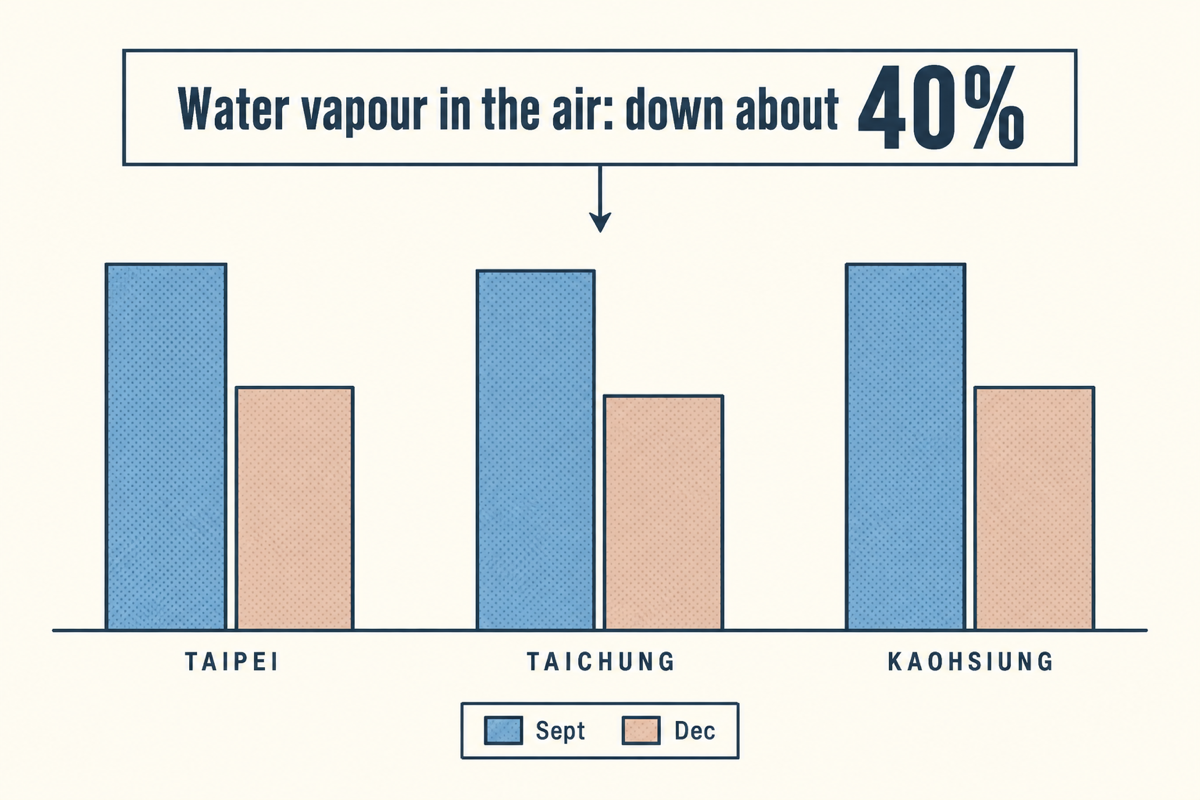
So what about Taiwan? Climate monthly means from the Central Weather Administration (CWA) for 1991–2020 show that from September to December, relative humidity rises slightly in Taipei but falls in Taichung and Kaohsiung. What all three stations share is a drop in temperature.
| Station | Mean temp, Sept → Dec | Relative humidity, Sept → Dec | Actual water vapour in air (converted) |
|---|---|---|---|
| Taipei | 27.7°C → 18.2°C | 73.8% → 75.6% | down about 40% |
| Taichung | 27.8°C → 18.7°C | 74.3% → 72.6% | down about 40% |
| Kaohsiung | 28.5°C → 21.2°C | 77.5% → 71.6% | down about 40% |
(Note: relative humidity measures *what proportion* of its capacity the air is holding, and colder air can hold less. The "converted" column is our own calculation from mean temperature and relative humidity using standard meteorological formulas, giving the change in absolute humidity in December relative to September. Indoor fan heaters and dehumidifiers compound the loss further.)
Put plainly: relative humidity at all three stations is still around 70% in December, but because the temperature has dropped, the air actually holds roughly 40% less water vapour. Indoor factors — heaters, dehumidifiers — are a separate matter. In 2015, Nam and colleagues at the Skin Research Institute, Amorepacific R&D Centre (South Korea) published "The seasonal variation in skin hydration, sebum, scaliness, brightness and elasticity in Korean females" in *Skin Research and Technology*, following 89 women across 13 consecutive months with one measurement per month. They found that the lower the temperature and relative humidity, the more pronounced the skin scaling — the two were negatively correlated (note: relative humidity in Seoul in February is only 46%).
Skin itself is changing too
The lipids in the surface layer of skin follow the seasons. In 1996, Rogers and colleagues at Unilever Research (UK) published "Stratum corneum lipids: the effect of ageing and the seasons" in *Archives of Dermatological Research*, analysing lipids from tape strippings taken from participants' face, hand and leg. They found stratum corneum lipids to be markedly lower in winter than in spring and summer, ceramides especially. In 2018, Fujiwara and colleagues in the R&D division of Meiji Co. (Japan) published "Age-related and seasonal changes in covalently bound ceramide content in forearm stratum corneum of Japanese subjects" in the same journal, measuring the forearms of 99 healthy adults aged 24 to 64. Total ceramide covalently bound to corneocytes in autumn and winter was roughly half the spring and summer level.
What these two studies say is that skin's baseline is thinner in autumn and winter to begin with. They do not say that putting lipids back will stop the itch.
Water temperature: a plausible trigger, especially alongside a cleansing product
In 2022, Herrero-Fernandez and colleagues in the Department of Dermatology, University of Granada (Spain) published "Impact of water exposure and temperature changes on skin barrier function" in the *Journal of Clinical Medicine*. Fifty healthy adults soaked their right hand in roughly 41°C hot water and their left hand in roughly 11°C cold water for 10 minutes each, with the palm measured immediately afterwards. The result — a single, immediate palm measurement — was that TEWL on the hot-water hand rose from 25.75 to 58.58, while the cold-water hand rose to 34.96; the hot-water hand also showed redness. After the same 10 minutes, the TEWL measured in the hot-water condition was about 1.7 times that of the cold-water condition.
In 1996, Ohlenschlaeger and colleagues in the Department of Dermatology, Gentofte Hospital, University of Copenhagen (Denmark) published "Temperature dependency of skin susceptibility to water and detergents" in *Acta Dermato-Venereologica*, with a design closer to everyday bathing: 20 healthy people soaked twice a day, 10 minutes per soak, for 2 consecutive days, with each person's left and right forearm assigned one water temperature each.
| Liquid soaked in | Arm at 20°C | Arm at 40°C |
|---|---|---|
| Plain water (10 people) | no significant change | no significant change |
| Solution containing a cleansing agent (10 people) | smaller rise in transepidermal water loss (TEWL) | markedly larger rise in transepidermal water loss (TEWL) |
Reading the two studies together: hot water on its own does cause a short-term loss of water from the skin, but what genuinely widens the gap is the combination of hot water plus a cleansing product.
2. Does bathing dry out your skin? Immersion vs showering, temperature and duration
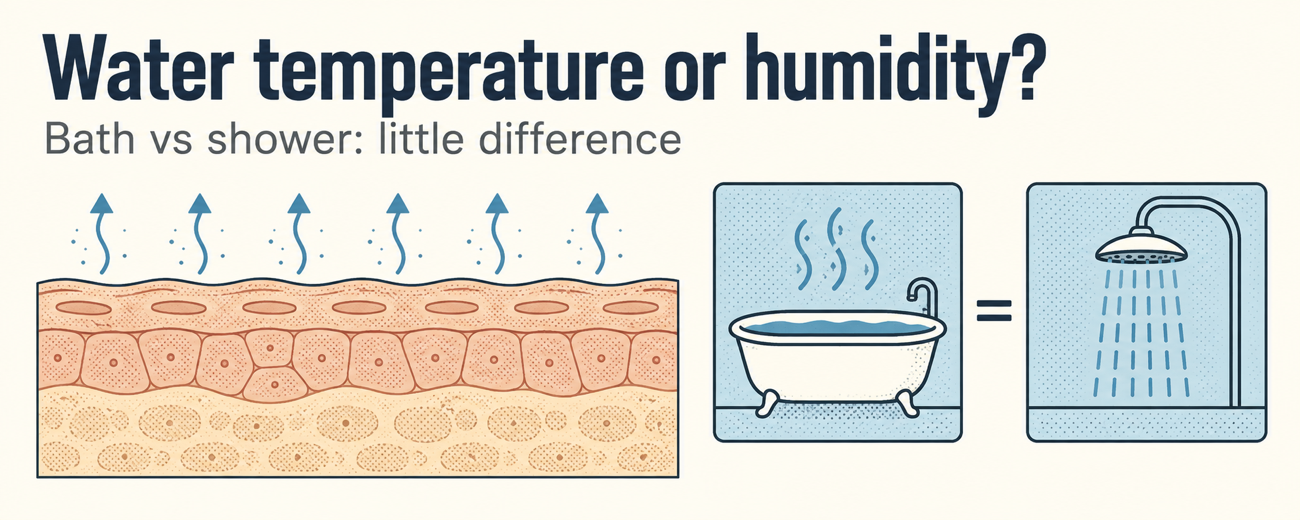
One study set out specifically to compare bathing with showering. In 2021, Nitiyarom and colleagues in Paediatric Dermatology at Siriraj Hospital, Mahidol University (Thailand) published "Skin hydration and transepidermal water loss after bathing compared between immersion and showering" in *Skin Research and Technology*. Seventy-eight healthy people aged 12 to 55 had 3 minutes of immersion on one forearm and 3 minutes of showering on the other, with measurements continuing over 10 minutes. The findings:
- Stratum corneum hydration: rose significantly after both immersion and showering, but the rise was only temporary — it fell away quickly within 3 minutes and was back to the pre-water level after 10 minutes.
- TEWL: rose significantly after both, and at every measurement within those 10 minutes it remained higher than before water exposure.
- Immersion vs showering: no statistical difference between the two methods on either marker at any time point.
In everyday terms: the "moist" feeling water gives skin is borrowed, and returned within 10 minutes — while the barrier that the water loosened has still not recovered after 10 minutes. So the choice between a bath and a shower makes little difference in itself. What matters is what follows: the water temperature, the duration, and whether you actually put the moisture back afterwards.
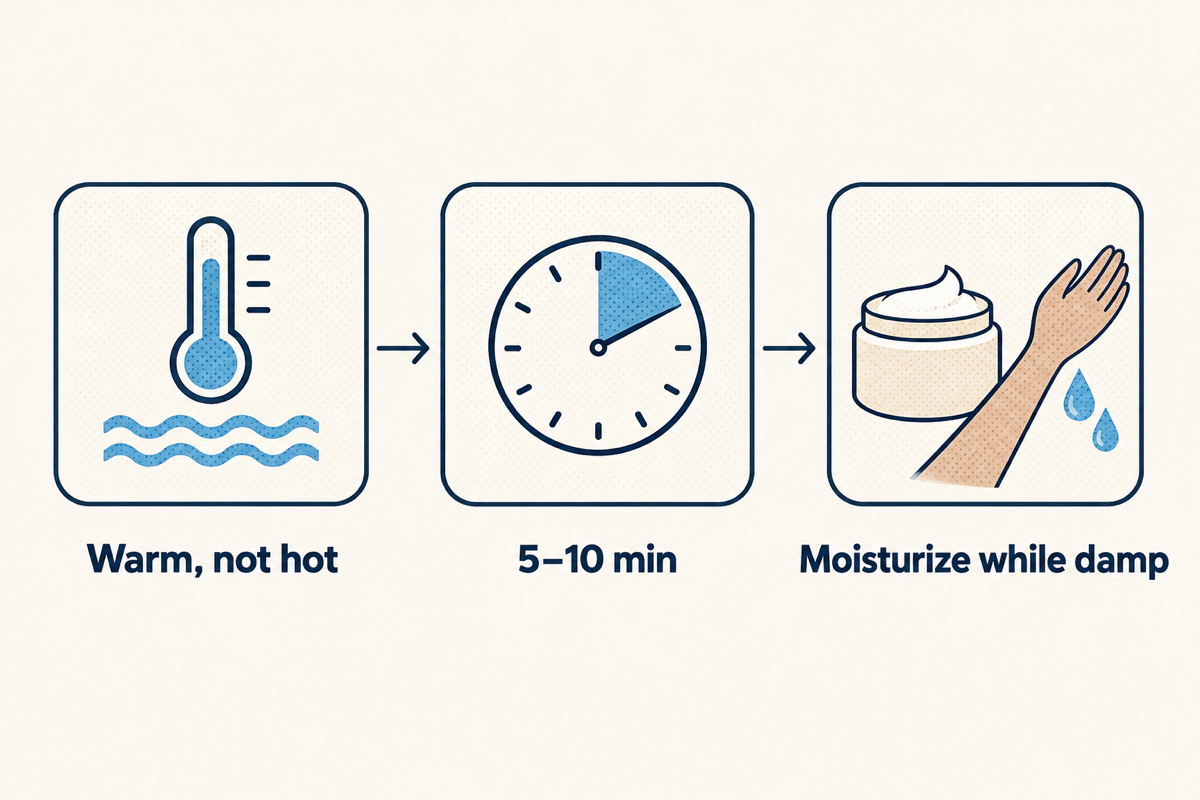
So what temperature, and how many minutes, counts as safe? Research does not offer one universal number. What can be referenced are two guideline positions. The American Academy of Dermatology recommends, for general dry skin, warm water and limiting a bath or shower to 5 to 10 minutes. Japan's Consumer Affairs Agency advises the public to keep bath water below 41°C for about 10 minutes — a recommendation set to avoid "heat shock" caused by temperature swings; the details are covered in our earlier article Is a hot spring better than a hot bath? Heat, water pressure and buoyancy, and what the balneotherapy evidence really shows. Three sentences to hold onto: keep the water comfortable rather than scalding, keep it short, and put the moisture back when you get out.
3. Moisturizing afterwards: how strong the timing evidence is, and how to choose a cleanser
Where "within 3 minutes" comes from
In 2009, Chiang and Eichenfield at the University of California, San Diego (USA) published "Quantitative assessment of combination bathing and moisturizing regimens on skin hydration in atopic dermatitis" in *Pediatric Dermatology*, measuring directly how long after a soak moisturizer was applied. The study enrolled 10 participants (5 adolescents with mild-to-moderate atopic dermatitis and 5 with healthy skin), soaked the arm in roughly 34°C tap water for 10 minutes with no cleansing product, then ran four regimens — each participant completed all four — tracking skin hydration over the following 90 minutes.
| Regimen | Mean hydration over 90 min | What was measured |
|---|---|---|
| 1. Soak only, no moisturizer | 91% | drier after the soak than before it |
| 2. Soak, then moisturize immediately | 142% | clearly replenished |
| 3. Soak, then moisturize 30 minutes later | 141% | almost identical to immediate |
| 4. No soak, moisturize directly | 206% | highest of the four |
(Figures are for the atopic dermatitis group: mean hydration across 90 minutes, with the pre-soak level set at 100%.)
Three findings come through clearly. Soaking without moisturizing leaves skin drier than before the soak. Moisturizing after the soak brings hydration back. And applying immediately versus 30 minutes later showed no discernible difference in this study. The healthy-skin group started from higher hydration than the atopic dermatitis group, and the ranking of the four regimens was the same.
The "within 3 minutes" figure comes from the National Eczema Association's care advice for people with eczema — apply moisturizer generously within 3 minutes of bathing to seal water in. The American Academy of Dermatology's wording for the general public is to apply while skin is still damp. Put the guidelines alongside Chiang and Eichenfield (2009) and they point the same way: moisturizing while you are still damp is the easiest version to remember and the hardest to forget; and if you miss those 3 minutes, applying is still far better than not applying.
Choosing a cleanser: watch the pH
In 2002, Baranda and colleagues in the Department of Dermatology, Hospital Central of San Luis Potosí (Mexico) published "Correlation between pH and irritant effect of cleansers marketed for dry skin" in the *International Journal of Dermatology*. Thirty participants with sensitive skin had 17 products marketed as suitable for dry skin and 12 ordinary soaps patched onto the forearm for 5 consecutive days, after which redness, scaling and fissuring were assessed. Irritation correlated significantly with the product's pH — the more alkaline, the more irritating — and the least irritating products were mostly synthetic detergents (syndets). Notably, a fair number of products labelled "suitable for dry skin" did not score low on irritation (note: this was a closed patch test, harsher than real-life use).
A few principles when choosing a cleanser:
- Pick something near-neutral in pH and labelled as mild. The words "for dry skin" do not by themselves mean mild.
- Following the American Academy of Dermatology, choose products labelled "fragrance-free". Products labelled "unscented" may contain ingredients added to mask odour.
- Shins, arms and back dry out easily — rinsing with water is enough there. You do not need to apply cleanser everywhere.
4. Hot springs and skin: what the research can and cannot say
People with dry, itchy skin often ask whether hot springs help. The research to date is mostly in populations with skin disease, which is a different situation from healthy skin that only turns dry and itchy in autumn and winter.
In 1997, Kubota and colleagues at the Kusatsu Branch, School of Medicine, Gunma University (Japan) published "Treatment of refractory cases of atopic dermatitis with acidic hot-spring bathing" in *Acta Dermato-Venereologica*. Seventy patients with refractory atopic dermatitis bathed twice a day in a 42°C acidic hot spring for 10 minutes per bath; 76% were reported to show improvement in skin symptoms, and among the 42 who improved, 30 had *Staphylococcus aureus* on the skin surface disappear or decrease. The study had no control group, the water was the strongly acidic Kusatsu spring, and what it measured was symptoms and bacteria — not dryness.
In 2022, Beylot-Barry and colleagues in the Department of Dermatology, Bordeaux University Hospital (France) published "Evaluation of the benefit of thermal spa therapy in plaque psoriasis: the PSOTHERMES randomized clinical trial" in the *International Journal of Biometeorology* — the most completely designed study available. One hundred and twenty-eight adults with plaque psoriasis were randomized into two groups: one went immediately to one of five French thermal spa centres for a 3-week course, the other continued usual care. At 4.5 months, 66.1% of the spa group had reached the quality-of-life target versus 41.4% of controls; self-rated itch fell from 6.7 to 4.3 in the spa group and from 6.8 to 5.4 in controls; but the lesion severity index (PASI) showed no difference between the groups. Participants knew what they had bathed in, and the course also included rest and a change of environment, so the effect cannot be attributed to the "water" itself. Funding came from the French association for thermal research.
For bathing at home, DaFang 1956's advice is simple: keep the water comfortable rather than scalding, start with a short soak, and choose an all-natural, fragrance-free product. How to use it — foot bath, half bath or full bath — is covered in No Bathtub? No Problem. A Complete Guide to Foot Baths, Half Baths, and Full Baths with Beitou White Sulfur Powder.
5. Warning signs: when to see a doctor
First, why scratching makes it worse. In 2020, Moniaga and colleagues at the Juntendo University Itch Research Centre (Japan) published "Mechanisms and management of itch in dry skin" in *Acta Dermato-Venereologica*, setting out the mechanism: when skin stays dry for a long period, the density of nerve endings in the epidermis increases, and the skin becomes more sensitive as a result. That is why leaving dry itch untreated makes it progressively easier to trigger.
Patient guidance from the UK's National Health Service (NHS) lists the situations that warrant seeing a doctor:
- the itch is already affecting your daily life or your sleep
- self-care has not improved it, or it keeps coming back
- it comes with a new rash, lump or swelling
- the itch is all over your body
- the itch is very severe
- it occurs during pregnancy
In these situations, changing the water temperature or changing your cleanser is not the answer. Please see a dermatologist for assessment.
Shared limitations of the research cited here: most of these studies measured surrogate markers such as transepidermal water loss (TEWL) and hydration, not itch itself; participant numbers ranged from 10 to 128; measurement sites were mostly the palm or forearm; and both hot-spring studies were in patients with skin disease. What this article sets out on that basis is the direction the research can support — not a guarantee that applies to every individual.
Medical boundary: this article is general skin-care information, not diagnosis or treatment advice. If you have atopic dermatitis, psoriasis or another skin condition, follow your treating physician's guidance on bathing and moisturizing.
FAQ
Q1: My skin itches after an autumn bath — is it the water temperature or the humidity? Both play a part. Relative humidity moves in different directions across Taiwan's three stations, but colder air means roughly 40% less actual water vapour — and meanwhile you turn the bath water up without noticing. The combination the research measured as hardest on skin is hot water plus a cleansing product.
Q2: Does bathing dry out your skin? In the short-duration comparison by Nitiyarom et al. (2021), bathing and showering showed no statistical difference on immediate skin markers. How hot, how long, what you wash with, and whether you put the moisture back afterwards all still need to be considered together.
Q3: Do I really have to moisturize within 3 minutes? "Within 3 minutes" is expert consensus from eczema care; the dermatology academy's wording is to apply while skin is still damp. Chiang and Eichenfield (2009) found that skin left without moisturizer after a soak ends up drier than before it, while skin that was moisturized — whether immediately or 30 minutes later — had its hydration restored. Applying while damp is easiest to remember; if you miss it, apply anyway.
Q4: What should I do about seasonal dry itch, and when should I see a doctor? Keep the water comfortable rather than scalding, shorten the time, choose a near-neutral and fragrance-free cleanser, and moisturize afterwards. See a dermatologist if the itch affects your life, self-care has not improved it, it is all over your body, it comes with a new rash or lump, or it occurs during pregnancy.
Further reading
- Sweating All Summer but Your Skin Still Feels Dry, Itchy, and Stinging? Common Causes, Care, and When to See a Doctor
- Is a hot spring better than a hot bath? Heat, water pressure and buoyancy, and what the balneotherapy evidence really shows
- No Bathtub? No Problem. A Complete Guide to Foot Baths, Half Baths, and Full Baths with Beitou White Sulfur Powder
Sources
- Engebretsen, K. A., Johansen, J. D., Kezic, S., Linneberg, A., & Thyssen, J. P. (2016). The effect of environmental humidity and temperature on skin barrier function and dermatitis. *Journal of the European Academy of Dermatology and Venereology*, 30(2), 223–249. https://doi.org/10.1111/jdv.13301
- Nam, G. W., Baek, J. H., Koh, J. S., & Hwang, J. K. (2015). The seasonal variation in skin hydration, sebum, scaliness, brightness and elasticity in Korean females. *Skin Research and Technology*, 21(1), 1–8. https://doi.org/10.1111/srt.12145
- Rogers, J., Harding, C., Mayo, A., Banks, J., & Rawlings, A. (1996). Stratum corneum lipids: The effect of ageing and the seasons. *Archives of Dermatological Research*, 288(12), 765–770. https://doi.org/10.1007/BF02505294
- Fujiwara, A., Morifuji, M., Kitade, M., Kawahata, K., Fukasawa, T., Yamaji, T., Itoh, H., & Kawashima, M. (2018). Age-related and seasonal changes in covalently bound ceramide content in forearm stratum corneum of Japanese subjects: Determination of molecular species of ceramides. *Archives of Dermatological Research*, 310(9), 729–735. https://doi.org/10.1007/s00403-018-1859-z
- Nitiyarom, R., Anuntarumporn, L., & Wisuthsarewong, W. (2021). Skin hydration and transepidermal water loss after bathing compared between immersion and showering. *Skin Research and Technology*, 27(5), 896–903. https://doi.org/10.1111/srt.13039
- Herrero-Fernandez, M., Montero-Vilchez, T., Diaz-Calvillo, P., Romera-Vilchez, M., Buendia-Eisman, A., & Arias-Santiago, S. (2022). Impact of water exposure and temperature changes on skin barrier function. *Journal of Clinical Medicine*, 11(2), 298. https://doi.org/10.3390/jcm11020298
- Ohlenschlaeger, J., Friberg, J., Ramsing, D., & Agner, T. (1996). Temperature dependency of skin susceptibility to water and detergents. *Acta Dermato-Venereologica*, 76(4), 274–276. https://doi.org/10.2340/0001555576274276
- Chiang, C., & Eichenfield, L. F. (2009). Quantitative assessment of combination bathing and moisturizing regimens on skin hydration in atopic dermatitis. *Pediatric Dermatology*, 26(3), 273–278. https://doi.org/10.1111/j.1525-1470.2009.00911.x
- Baranda, L., González-Amaro, R., Torres-Alvarez, B., Alvarez, C., & Ramírez, V. (2002). Correlation between pH and irritant effect of cleansers marketed for dry skin. *International Journal of Dermatology*, 41(8), 494–499. https://doi.org/10.1046/j.1365-4362.2002.01555.x
- Moniaga, C. S., Tominaga, M., & Takamori, K. (2020). Mechanisms and management of itch in dry skin. *Acta Dermato-Venereologica*, 100(2), adv00024. https://doi.org/10.2340/00015555-3344
- Kubota, K., Machida, I., Tamura, K., Take, H., Kurabayashi, H., Akiba, T., & Tamura, J. (1997). Treatment of refractory cases of atopic dermatitis with acidic hot-spring bathing. *Acta Dermato-Venereologica*, 77(6), 452–454. https://doi.org/10.2340/0001555577452454
- Beylot-Barry, M., Mahé, E., Rolland, C., de la Bretèque, M. A., Eychenne, C., Charles, J., Payen, C., Machet, L., Vermorel, C., Foote, A., Roques, C., & Bosson, J. L. (2022). Evaluation of the benefit of thermal spa therapy in plaque psoriasis: The PSOTHERMES randomized clinical trial. *International Journal of Biometeorology*, 66(6), 1247–1256. https://doi.org/10.1007/s00484-022-02273-7
Author lists follow APA 7th from Europe PMC bibliographic records (verified 2026-09-14); items 6 and 8 also have full text readable on PMC, the rest are abstracts.
Guidelines and official data
- G1. American Academy of Dermatology (page marked updated 2026-01-02). Dermatologists' top tips for relieving dry skin. https://www.aad.org/public/everyday-care/skin-care-basics/dry/dermatologists-tips-relieve-dry-skin
- G2. National Eczema Association (page marked medically reviewed 2025-03-21). Moisturizing. https://nationaleczema.org/eczema/treatment/moisturizing/
- G3. NHS (page marked reviewed 2023-07-19). Itchy skin. https://www.nhs.uk/conditions/itchy-skin/
- D1. Central Weather Administration, MOTC. Climate monthly means (1991–2020), temperature and relative humidity at the Taipei, Taichung and Kaohsiung stations (retrieved 2026-09-14). https://www.cwa.gov.tw/V8/C/C/Statistics/monthlymean.html