

Other language versions: 繁體中文 · 日本語
The short version
- In a randomised trial in the UK, people who soaked both feet in 10°C water for 20 minutes went on to report a cold over the next 4 to 5 days at a rate of 14.4%, against 5.6% in the control groupnote 1.
- Researchers at Harvard Medical School in the US measured a drop of up to 6.4°C in the front of the nasal cavity when people moved from a 23.3°C room into a 4.4°C environment; lowering the temperature by 5°C in the laboratory cut the antiviral vesicles released by the nasal lining by 41.9%note 2.
- A hot drink taken when a cold is coming on made all six complaints, runny nose, cough, sneezing, sore throat, chilliness and tiredness, feel better, while the instrument-measured nasal airflow did not change at allnote 3.
- A Japanese study found that young children who usually bathe in 39°C to 40°C water were less likely to have seen a doctor for a cold that month; at 41°C and above there was no differencenote 4. When there is a fever, or a cold remedy has just been taken, leave the hot bath alone for now.
As soon as the weather turns, the experience is a familiar one: bare feet on a cold floor in the evening, and by the next morning the throat feels off. Older relatives have always said to keep socks on or you will catch cold. Is there anything behind it? This article gathers research from the UK, the US, Finland and Japan to answer three questions. Is cold feet genuinely linked to catching a cold? If so, through what mechanism? And when a cold is already coming on and the nose is blocking up, what can a foot bath, a hot bath, steam and a hot drink each do, and what can they not do?
Soak the feet in cold water, and more cold symptoms follow over the next few days
In 2005 Johnson and Eccles of the Common Cold Centre at Cardiff University in the UK published "Acute cooling of the feet and the onset of common cold symptoms" in Family Practice. They recruited 180 healthy university students and randomised them by computer into two groups: one sat in a room at 18°C to 25°C with both feet in 10°C water for 20 minutes, the other kept shoes and socks on with their feet in an empty bowl for 20 minutes. Over the following days, both groups recorded whether they had any cold symptoms.
| Measure | Cold water group | Control group |
|---|---|---|
| Reported a cold over the next 4 to 5 days | 13 of 90 (14.4%) | 5 of 90 (5.6%) |
| Mean total symptom score, days 1 to 4 | 5.16 | 2.89 |
Both differences reached statistical significancenote 1. Worth noting: immediately after the soak the two groups did not differ in symptom score at all. The gap only opened up several days later.
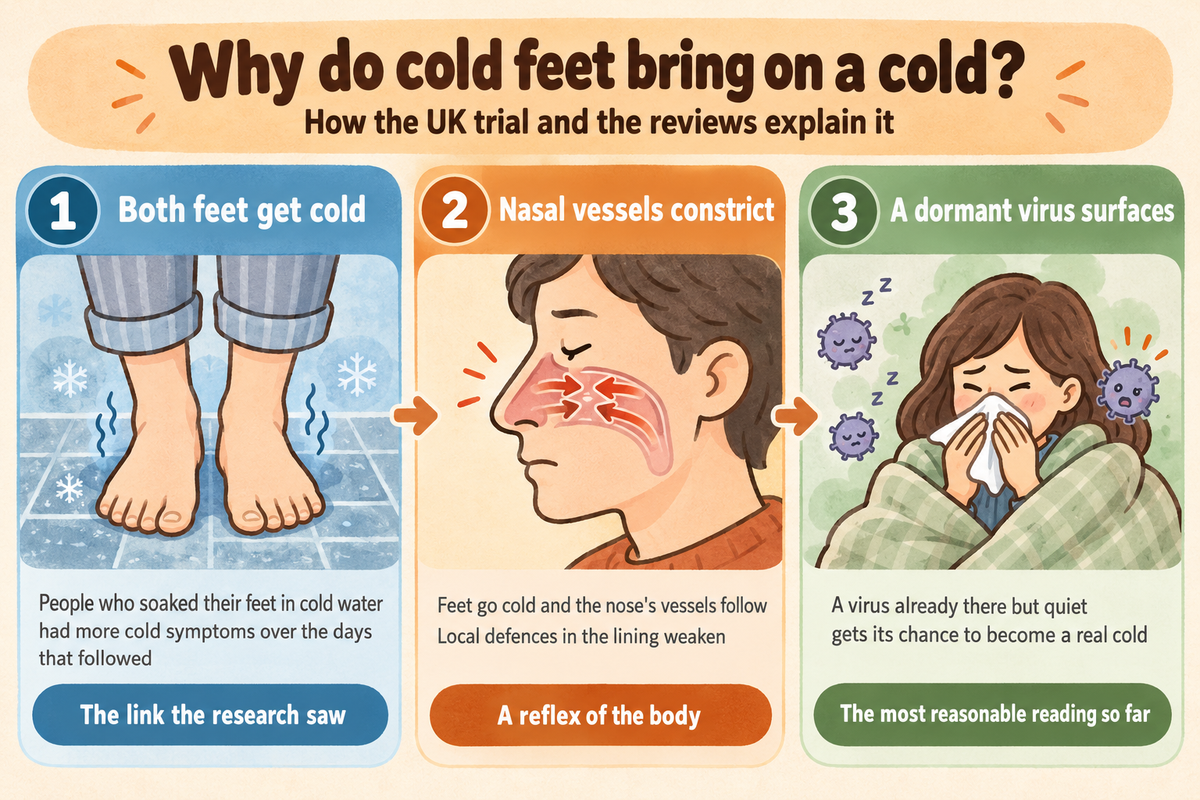
The authors' explanation is that a good many people are already carrying a cold virus that has not yet declared itself. When both feet are chilled, the blood vessels in the lining of the nose and throat constrict by reflex, local defences weaken, and an infection that was going nowhere gets its opening. This phenomenon of the feet going cold and the blood vessels in the nose constricting with them was demonstrated as early as 1961, when Drettner found in 50 subjects that cooling the back, or placing the feet in cold water, visibly constricted the nasal blood vessels and blanched the lining. The 2015 review "Exposure to cold and acute upper respiratory tract infection" by Eccles and Wilkinson in Rhinology cites that experiment, and sorts cold exposure into four kinds: breathing cold air, eating cold food, body-surface cooling and whole-body hypothermia. Its conclusion is that breathing cold air and body-surface cooling are the two with research behind them for a link to upper respiratory infectionnote 5.
The same account also explains why the older experiments, the ones that dripped virus into the nose first and then chilled the subjects, found no difference. In his 2023 review "Common cold" in Frontiers in Allergy, Eccles points out that those experiments did not reflect real life, and that in everyday conditions the effect of getting cold looks more like giving an infection already lying dormant its chance to surfacenote 6.
Cold feet are linked to cold symptoms appearing over the following days, and the more reasonable reading is that chilling lets a dormant virus surface, rather than that cold itself manufactures a cold.
A cold nose means weaker defences: the evidence from cells to people
Why should nasal temperature matter so much? Foxman and colleagues in the Iwasaki laboratory at Yale University in the US published "Temperature-dependent innate defense against the common cold virus limits viral replication at warm temperature in mouse airway cells" in the Proceedings of the National Academy of Sciences (PNAS) in 2015, noting that most rhinoviruses replicate better at the 33°C to 35°C of the nasal cavity than at the 37°C of core body temperature. Comparing mouse airway epithelial cells at 33°C and 37°C, they found the antiviral response markedly weaker at the lower temperature, which let the virus replicate more freelynote 7. The following year the same team switched to human bronchial epithelial cells and found that at 37°C the cells have two further mechanisms for suppressing the virus, confirming again that temperature shapes a cell's ability to fight the common cold virusnote 8.
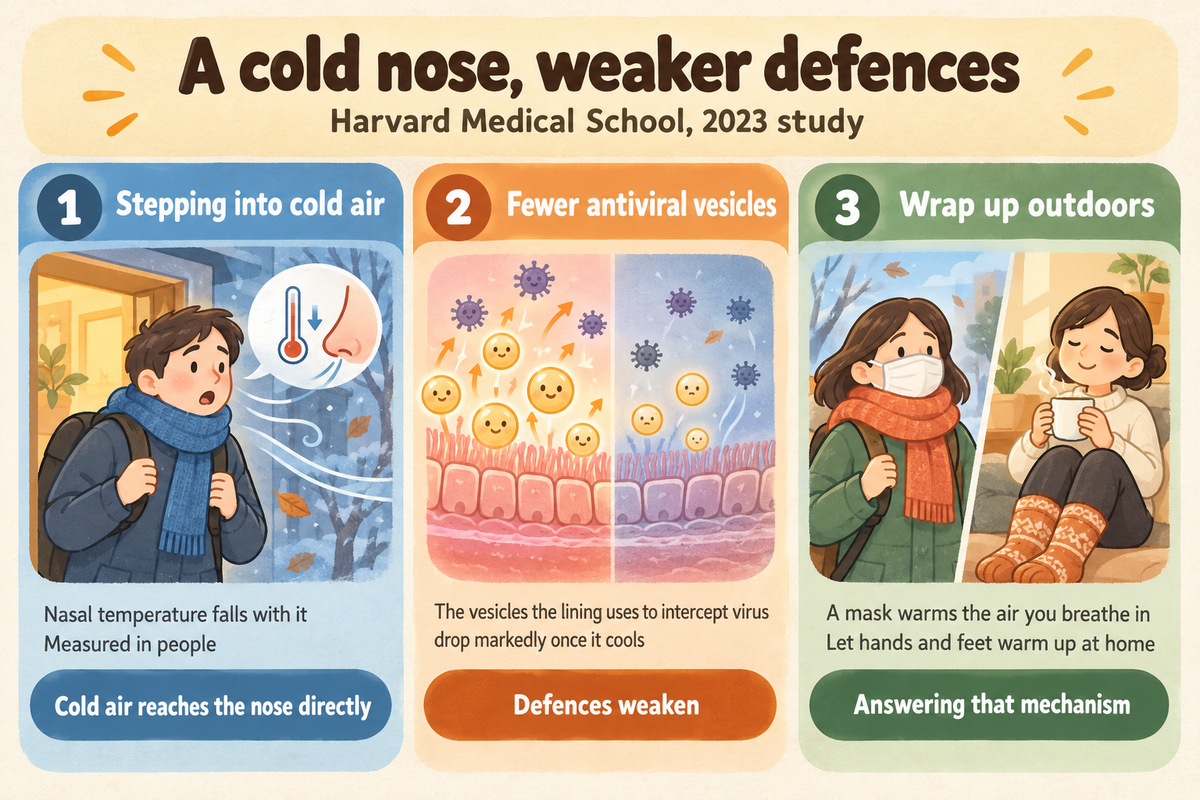
So how much does a nose actually cool when someone walks out into cold air? That question was answered in 2023 by Huang and colleagues of Massachusetts Eye and Ear at Harvard Medical School in the US, in "Cold exposure impairs extracellular vesicle swarm-mediated nasal antiviral immunity" in the Journal of Allergy and Clinical Immunology. Moving healthy subjects from a 23.3°C environment to one at 4.4°C, the team measured a fall of up to 6.4°C in the front of the nasal cavity and 4.7°C in the middle. They then worked with human nasal mucosa obtained at surgery: when the lining is challenged with a virus mimic it releases a great many extracellular vesicles (EVs), which intercept virus like decoys. Lower the temperature by 5°C and total EV release fell by 41.9%, while the antiviral small molecules carried per vesicle fell by 23.8%note 2.
The population-level data come from Finland. In 2009 Mäkinen and colleagues at the University of Oulu published "Cold temperature and low humidity are associated with increased occurrence of respiratory tract infections" in Respiratory Medicine. Following 892 conscripts and matching outdoor temperature and humidity in the days before each confirmed case, they estimated that every 1°C fall in temperature raised the risk of a common cold by 2.1%, and every 1 g/m³ fall in absolute humidity raised the risk of upper respiratory infection by 10.0%note 9.
| Study | Subjects | Finding |
|---|---|---|
| Foxman et al. (2015) | Mouse airway cells | Antiviral response weaker at 33°C than at 37°C |
| Foxman et al. (2016) | Human bronchial cells | Two further mechanisms suppress the virus at 37°C |
| Huang et al. (2023) | Healthy adults and human nasal mucosa | Cold environment cools the nose by up to 6.4°C; a 5°C drop cuts antiviral EVs by 41.9% |
| Mäkinen et al. (2009) | 892 Finnish conscripts | Every 1°C fall in temperature raises estimated cold risk by 2.1% |
When nasal temperature falls, the lining's capacity to fight virus falls with it, and that is what "keep warm" means mechanistically on a cold day. In Taiwan, on the days a front passes through and morning and evening swing far apart, wearing a mask outdoors so the air warms before it is breathed in, and letting hands and feet come back up to temperature once home, are both ways of answering that mechanism.
A hot drink when a cold is coming on: feeling better is real
In 2008 Sanu and Eccles of the Common Cold Centre at Cardiff University in the UK published "The effects of a hot drink on nasal airflow and symptoms of common cold and flu" in Rhinology. They recruited 30 adults who had had cold or flu-like symptoms for under 7 days and randomised them into two groups, each given 100 ml of the same apple and blackcurrant juice: one group at 70°C, the other at 20°C. Nasal airflow was measured by instrument while the subjects scored each symptom.
| Symptom | Hot drink group | Room temperature group |
|---|---|---|
| Runny nose, cough, sneezing | Felt relieved | Felt relieved |
| Sore throat, chilliness, tiredness | Felt relieved | No clear improvement |
| Blocked nose (subjective) | Felt relieved | No clear improvement |
| Instrument-measured nasal airflow | No change | No change |
Relief from the hot drink began at the first sip and held to the end of the observationnote 3. The hot drink did not actually open the nose, but it did make several cold complaints noticeably more bearable. The authors suggest the taste and the warmth stimulate saliva and airway mucus, lubricating and soothing the throat and upper airway. When a cold is coming on, a warm cup of tea or soup is the cheapest and the safest comfort there is.
Steam for a blocked nose: a way to feel better, not a treatment
Plenty of people lean over a bowl of hot water when the nose blocks up. In 2017 Singh and colleagues of the Postgraduate Institute of Medical Education and Research in Chandigarh, India published "Heated, humidified air for the common cold" in the Cochrane Database of Systematic Reviews, pooling 6 trials covering 387 people with colds who inhaled heated air through a dedicated heated humidifier. Some trials showed symptoms improving, others did not; the US trial found nasal resistance worsened while the Israeli trial saw improvement, and the overall quality of evidence was rated low. The authors concluded that the current evidence shows no benefit of this therapy for the common cold, and no harm either; one trial reported mild burns to the nasal liningnote 10.
For people with long-standing congestion, Little and colleagues at the University of Southampton in the UK published "Effectiveness of steam inhalation and nasal irrigation for chronic or recurrent sinus symptoms in primary care" in CMAJ in 2016. Across 72 primary care practices in the UK they randomised 871 patients into four groups, usual care, nasal irrigation, steam inhalation and both combined, and followed them for 6 months. Steam inhalation reduced headache only, with no improvement on any other measurenote 11.
The National Health Service (NHS) advice page on the common cold suggests sitting in a bathroom with the hot shower running and breathing the steam when the nose is blocked, while warning against having children inhale over a bowl of hot water because of the scalding riskG1. To ease a blocked nose with steam, the warm vapour in the bathroom during a hot shower is enough, and there is no need to breathe hard over scalding water.
Coming down with something? Do a foot bath or a hot bath help?
The most recent work looking directly at bathing and colds comes from Japan. In 2026 Kotsugai and colleagues of the Research and Development Headquarters at Earth Corporation published "Association between bathing habits and infections such as the common cold: a case-control study of children aged 3 to 5 years and their parents" in the Japanese Journal of Public Health, surveying the bathing habits of 1,968 young children and their parents in November 2024 and comparing those who saw a doctor that month for a cold or similar infection with those who had no symptoms. Taking a usual water temperature of 38°C and below as the reference, the results were as follows.
| Child's usual water temperature | Odds ratio for seeing a doctor for a cold |
|---|---|
| 38°C and below | 1 (reference) |
| 39°C to 40°C | 0.641 (significantly lower) |
| 41°C and above | 0.928 (no significant difference) |
Where the parent also met the bathing pattern defined in the study, 39°C to 40°C, water up to chest or shoulder level, and 7 to 20 minutes in the bath, the odds ratio was 0.810, likewise significantly lowernote 4. What goes with fewer visits to the doctor for a cold, in other words, is warmth, not the hottest water available.
Longer-run data come from Finland. In 2017 Kunutsor and colleagues at the University of Bristol in the UK published "Frequent sauna bathing may reduce the risk of pneumonia in middle-aged Caucasian men" in Respiratory Medicine, following 2,210 Finnish men aged 42 to 61 for a median of 25.6 years. Men who took a sauna 2 to 3 times a week had 0.72 times the risk of hospital admission for pneumonia of those taking 1 a week or fewer, and those going 4 times a week or more had 0.63 times the risknote 12. This shows that a regular habit of heat exposure goes with respiratory health, but the outcome studied was pneumonia, not the common cold.
As for how hot and how long suits, in 2018 Goto and colleagues of the Japan Health and Research Institute published "Physical and mental effects of bathing: a randomized intervention study" in Evidence-Based Complementary and Alternative Medicine, asking 38 healthy adults to bathe daily in 40°C water for 10 minutes over two weeks and comparing that with two weeks of showering only. Self-rated fatigue, stress and pain were all better during the bathing periodnote 13.
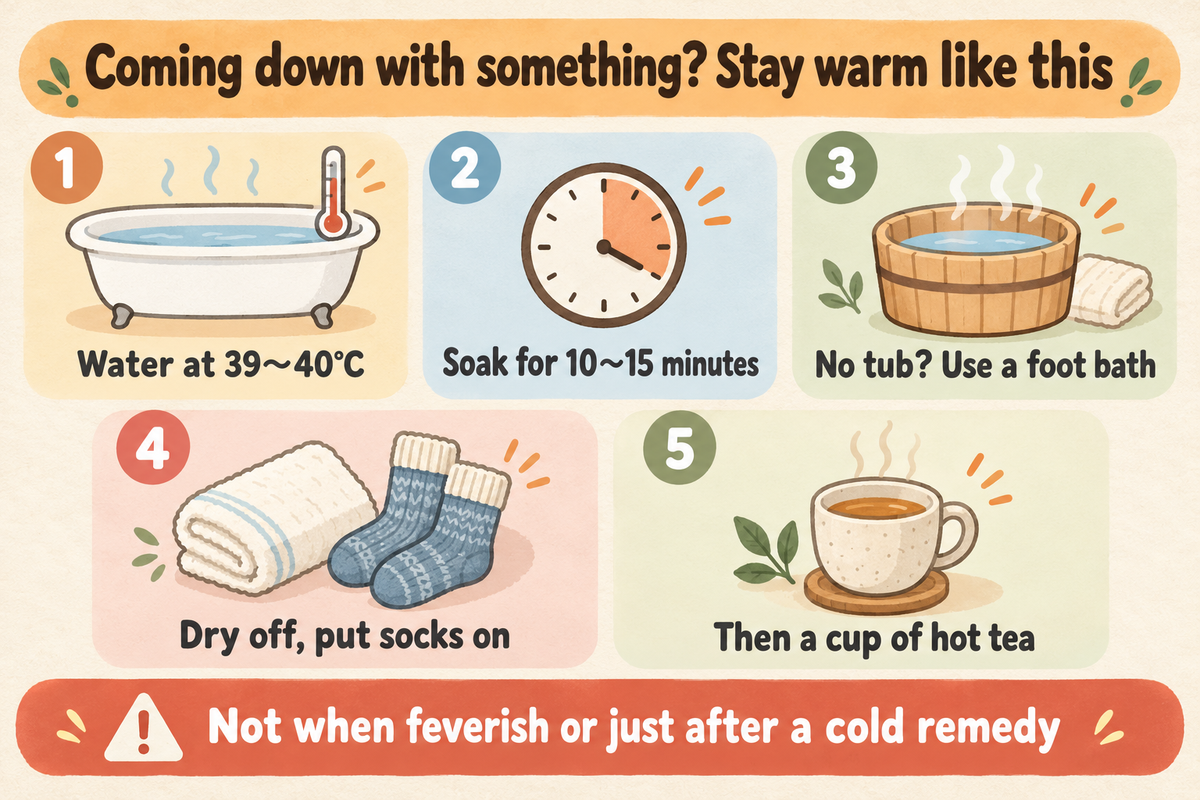
Putting the research and the official guidance together, this is what to do when a cold is coming on and the nose is uncomfortable.
- Keep the water at 39°C to 40°C: what went with fewer visits to the doctor for a cold in the Japanese study was 39°C to 40°C, and 41°C and above was no better; the Consumer Affairs Agency of Japan also advises keeping the water at or below 41°CG2.
- 10 to 15 minutes: the Consumer Affairs Agency of Japan advises staying in for under 10 minutes, and the Health Promotion Administration advises no more than 15 minutes in a hot spring in cold weatherG2 G3.
- No bathtub? A foot bath will do: chilled feet constrict the blood vessels in the nose, and a foot bath is the most direct way to warm the feet back up; for water temperature and timing, see How Warm Is a 41°C Footbath? Water Temp, Timing & a 10-Minute Pre-Sleep Ritual.
- Dry off and put socks on straight away: do not let feet that have just warmed up go cold again on a chilly floor.
- Take something warm to drink: a cup of hot tea or soup alongside, answering the hot drink research in the section above.
For anyone used to adding Beitou white sulfur hot spring powder to the bath or the foot bath, the same 39°C to 40°C and 10 to 15 minutes apply; DaFang white sulfur hot spring powder is natural hot spring sediment with no added fragrance. The point of a bath or a foot bath when a cold is coming on is to let the body warm up and rest, so comfortably warm is enough, and there is no need for very hot water or a long soak.
Where the medical line falls
In the following situations, leave the hot bath, the foot bath and the sauna alone for now.
- With a fever, or feeling clearly unwell: a 2026 review by a Japanese emergency medicine team notes that sauna should be avoided during acute illness or fever, because heat exposure adds to heat accumulation and circulatory load within a short timenote 14.
- Just after a cold remedy, after drinking, or just after a meal: the Consumer Affairs Agency of Japan advises against bathing at these timesG2.
- For people with high blood pressure, diabetes or high blood lipids: the Health Promotion Administration advises keeping hot spring water below 40°C and avoiding alternating hot and cold waterG3.
If cold symptoms have not improved after 10 days, a cough has run beyond 3 weeks, or a high fever will not settle or breathing becomes difficult, see a doctorG1.
FAQ
Q: Does cold feet really cause a cold?
The randomised trial in the UK found that people who soaked both feet in cold water for 20 minutes went on to report a cold over the next 4 to 5 days at a higher rate (14.4%) than the control group (5.6%)note 1. The more reasonable reading at present is that chilled feet constrict the blood vessels in the nose and weaken defences, giving a virus already lying dormant its chance to surfacenote 6.
Q: Does eating ice or drinking cold drinks in winter make a cold more likely?
Having gone through the literature on cold exposure and upper respiratory infection, Eccles and Wilkinson (2015) found no evidence linking cold food or cold drinks to colds. What does have research behind it is breathing cold air and body-surface coolingnote 5.
Q: Does inhaling steam help a blocked nose?
The Cochrane systematic review, pooling 6 trials and 387 people with colds, found no demonstrable benefit of heated humidified air for the common coldnote 10. What the NHS suggests is sitting in a bathroom with the hot shower running and breathing the steam, with a warning against children inhaling over a bowl of hot water because of the scalding riskG1.
Q: Do these methods apply to a blocked nose from allergic rhinitis?
The studies cited here all concern the common cold. Allergic rhinitis arises differently, so follow your doctor's instructions.
Further reading
- Cold Hands and Feet Keeping You Awake? The Science of Peripheral Circulation and the Pre-Sleep Footbath
- How Warm Is a 41°C Footbath? Water Temp, Timing & a 10-Minute Pre-Sleep Ritual
- No Bathtub? No Problem. A Complete Guide to Foot Baths, Half Baths, and Full Baths with Beitou White Sulfur Powder
Sources
- Johnson, C., & Eccles, R. (2005). Acute cooling of the feet and the onset of common cold symptoms. Family Practice, 22(6), 608–613. https://doi.org/10.1093/fampra/cmi072
- Huang, D., Taha, M. S., Nocera, A. L., Workman, A. D., Amiji, M. M., & Bleier, B. S. (2023). Cold exposure impairs extracellular vesicle swarm-mediated nasal antiviral immunity. Journal of Allergy and Clinical Immunology, 151(2), 509–525.e8. https://doi.org/10.1016/j.jaci.2022.09.037
- Sanu, A., & Eccles, R. (2008). The effects of a hot drink on nasal airflow and symptoms of common cold and flu. Rhinology, 46(4), 271–275.
- 小番美鈴、奥川洋司、中西信之、尾島俊之、早坂信哉(2026)。入浴法と風邪などの感染症罹患との関連:3~5歳児とその保護者による症例対照研究。日本公衆衛生雑誌(早期公開)。https://doi.org/10.11236/jph.25-029
- Eccles, R., & Wilkinson, J. E. (2015). Exposure to cold and acute upper respiratory tract infection. Rhinology, 53(2), 99–106. https://doi.org/10.4193/Rhin14.239
- Eccles, R. (2023). Common cold. Frontiers in Allergy, 4, 1224988. https://doi.org/10.3389/falgy.2023.1224988
- Foxman, E. F., Storer, J. A., Fitzgerald, M. E., Wasik, B. R., Hou, L., Zhao, H., Turner, P. E., Pyle, A. M., & Iwasaki, A. (2015). Temperature-dependent innate defense against the common cold virus limits viral replication at warm temperature in mouse airway cells. Proceedings of the National Academy of Sciences, 112(3), 827–832. https://doi.org/10.1073/pnas.1411030112
- Foxman, E. F., Storer, J. A., Vanaja, K., Levchenko, A., & Iwasaki, A. (2016). Two interferon-independent double-stranded RNA-induced host defense strategies suppress the common cold virus at warm temperature. Proceedings of the National Academy of Sciences, 113(30), 8496–8501. https://doi.org/10.1073/pnas.1601942113
- Mäkinen, T. M., Juvonen, R., Jokelainen, J., Harju, T. H., Peitso, A., Bloigu, A., Silvennoinen-Kassinen, S., Leinonen, M., & Hassi, J. (2009). Cold temperature and low humidity are associated with increased occurrence of respiratory tract infections. Respiratory Medicine, 103(3), 456–462. https://doi.org/10.1016/j.rmed.2008.09.011
- Singh, M., Singh, M., Jaiswal, N., & Chauhan, A. (2017). Heated, humidified air for the common cold. Cochrane Database of Systematic Reviews, 2017(8), CD001728. https://doi.org/10.1002/14651858.CD001728.pub6
- Little, P., Stuart, B., Mullee, M., Thomas, T., Johnson, S., Leydon, G., Rubinstein, I., Moore, M., Williamson, I., Lewith, G., Fry, J., & Bell, N. (2016). Effectiveness of steam inhalation and nasal irrigation for chronic or recurrent sinus symptoms in primary care: A pragmatic randomized controlled trial. CMAJ, 188(13), 940–949. https://doi.org/10.1503/cmaj.160362
- Kunutsor, S. K., Laukkanen, T., & Laukkanen, J. A. (2017). Frequent sauna bathing may reduce the risk of pneumonia in middle-aged Caucasian men: The KIHD prospective cohort study. Respiratory Medicine, 132, 161–163. https://doi.org/10.1016/j.rmed.2017.10.018
- Goto, Y., Hayasaka, S., Kurihara, S., & Nakamura, Y. (2018). Physical and mental effects of bathing: A randomized intervention study. Evidence-Based Complementary and Alternative Medicine, 2018, 9521086. https://doi.org/10.1155/2018/9521086
- Yokoyama, R., Yarimizu, K., Hayasaka, T., Sakaguchi, K., Kuroki, M., Soekawa, K., Kobayashi, T., & Konta, T. (2026). Acute heat exposure-related illness: A unified emergency medicine framework for hot baths, hot springs, and saunas: A narrative review. Journal of Clinical Medicine, 15(5), 1910. https://doi.org/10.3390/jcm15051910
Guidance and official sources (not research evidence, listed separately)
- G1. National Health Service (NHS). Common cold. Page reviewed 2024-03-22; accessed 2026-10-26. https://www.nhs.uk/conditions/common-cold/
- G2. Consumer Affairs Agency of Japan. 年末年始に増加する高齢者の事故(浴室での溺水). Accessed 2026-10-26. https://www.caa.go.jp/policies/policy/consumer_safety/caution/caution_067/index.html
- G3. Health Promotion Administration, Ministry of Health and Welfare, Taiwan. 健康泡湯六要項 (MOHW press release). Accessed 2026-10-26. https://mohw.gov.tw/cp-16-64512-1.html
Notes
- Johnson and Eccles (2005): university students at Cardiff University in the UK; 13 of 90 in the cold water group and 5 of 90 in the control group reported a cold (P = 0.047); total symptom score 5.16 against 2.89 (P = 0.013). The study did not test for virus, and the cold was self-reported. The authors also note that a subject who believes cold causes colds may be influenced in that self-report. Funding came from Cardiff University and the authors declared no conflict of interest.
- Huang et al. (2023): the number of subjects for the nasal temperature measurement is given in the online supplement. The EV experiments used human nasal mucosa and nasal epithelial cells obtained at surgery, stimulated with a virus mimic, and did not follow up whether the subjects actually caught a cold.
- Sanu and Eccles (2008): 15 people per group, no placebo arm and no blinding; the authors state themselves that the symptom relief may include a placebo effect. Funding came from the Common Cold Centre at Cardiff University, with no commercial sponsorship.
- Kotsugai et al. (2026): a case-control study in which water temperature was the respondent's own account of the water heater setting; subjects were members of an online survey panel rather than a national random sample; what was observed was everyday bathing habit, not the effect of bathing once a cold has already started. Funding came from the bath additive company Bathclin, and three of the authors are employed by that company. The odds ratio for the full bathing pattern in young children was 0.810, with the upper bound of the 95% confidence interval at 1.000, which makes it a borderline result.
- Eccles and Wilkinson (2015) is a narrative review; Drettner's 1961 experiment is cited through it. The authors disclose that Eccles has acted as a consultant to Unilever and that Wilkinson is a Unilever employee.
- Eccles (2023) is a narrative review and the author declared no conflict of interest.
- Foxman et al. (2015) is a mouse cell experiment, and the authors state that whether human cells behave the same way remains to be studied; funded by the National Institutes of Health in the US.
- Foxman et al. (2016) used human bronchial epithelial cells and HeLa cells. It is laboratory work with no human trial.
- Mäkinen et al. (2009) is an observational study, and the authors state that it can establish association only, not causation. The setting was northern Finland, where onset was most common at temperatures of 0°C to minus 5°C, far colder than a Taiwanese winter.
- Singh et al. (2017): the included trials used a dedicated heated humidifier (RhinoTherm) rather than a home facial steamer or bathroom steam, and the quality of evidence was rated low.
- Little et al. (2016): subjects were adults aged 18 to 65 with chronic or recurrent sinus symptoms, not acute colds; follow-up was slightly below 80%. Funded by the National Institute for Health Research in the UK.
- Kunutsor et al. (2017): a prospective cohort study limited to middle-aged Finnish men, with hospital-diagnosed pneumonia as the outcome. Almost everyone in the study took saunas, so no comparison with people who take none is possible, and residual confounding cannot be ruled out.
- Goto et al. (2018): a crossover trial in 38 people, with a small sample and no washout period; the common cold was not measured.
- Yokoyama et al. (2026) is a narrative review from Japanese emergency medicine, written about saunas. This article extends the same heat exposure principle to a safety note about hot baths.