
You've probably experienced it: you sleep for 8 hours, yet wake up exhausted.
Sleep deprivation isn't just about feeling tired. Chronic sleep disturbances harm immunity, metabolism, emotional resilience, and accelerate aging. The real problem modern people face isn't how long we sleep — it's our inability to achieve true deep sleep.
Recently, a customer using DaFang white sulfur spa powder voluntarily shared their Garmin smartwatch data. The numbers were remarkable enough that we decided this story deserved a full article.
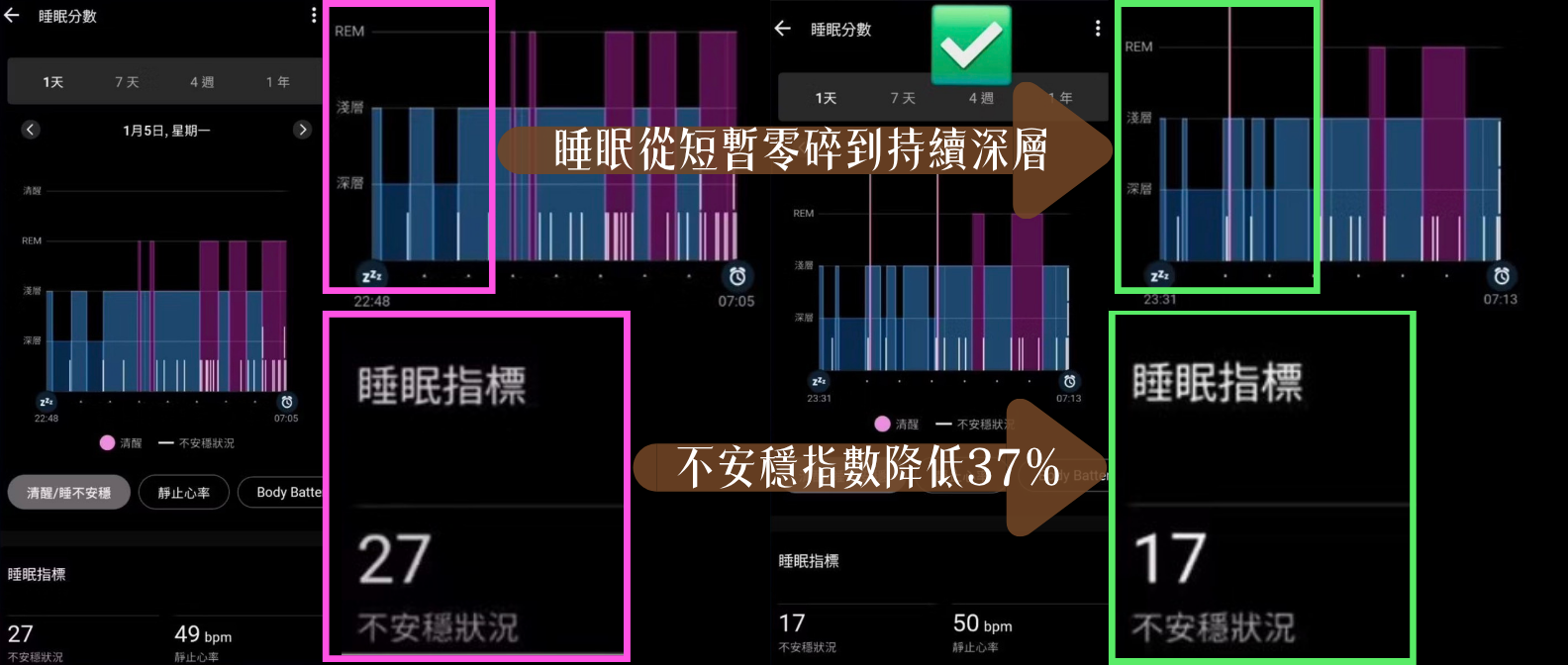
Real Garmin Sleep Data from One Customer
This customer didn't set out to run an experiment. He simply started taking warm baths before bed.
The before-and-after sleep data he shared tells the story:
| Metric | Before Bathing (Control) | After Using Spa Powder | Change |
|---|---|---|---|
| Restless Moments (count) | 27 | 17 | ▼ 37% |
| Resting Heart Rate (bpm) | 49 | 50 | Stable |
| Sleep Duration | 22:48 – 07:05 | 23:31 – 07:13 | ~8 hours (similar) |
| Deep Sleep Quality | Fragmented, shallow layers | Continuous, thick blocks | Noticeably improved |
The key isn't sleeping longer — it's sleeping deeper.
Looking at the Garmin sleep graphs clearly shows:
- The deep sleep blocks (navy blue) are thicker and more continuous after bathing, indicating longer sustained periods in restorative sleep
- White markers indicating restless moments decreased dramatically from 27 instances to 17
- Resting heart rate remained stable at 49–50 bpm, showing the body experienced no nighttime stress or discomfort
- Deep sleep was entered quickly in the post-bath night, indicating better sleep initiation
This data comes from the customer's watch — objective measurement, not subjective feeling, not brand marketing hype.
Why Does Bathing Improve Sleep? Three Scientific Mechanisms
Mechanism #1: Thermoregulation — The Body's Natural Sleep Trigger
When your body prepares to enter deep sleep, your core temperature actively decreases. This cooling signal is the key that tells your brain to initiate sleep mode.
Taking a warm bath (ideally 38–40°C / 100–104°F) first raises your core temperature. When you exit the bath, your temperature begins dropping rapidly, mimicking the "cool-down signal" your brain expects for sleep onset, allowing you to bypass shallow sleep and move directly into deep sleep.
Research shows that bathing 1–2 hours before sleep shortens time-to-sleep and increases the proportion of slow-wave sleep (deep sleep). This aligns perfectly with our customer's Garmin graph.
Mechanism #2: Mineral Absorption — Magnesium's Neurological Calming Effect
DaFang white sulfur spa powder is sourced from Beitou's natural white sulfur mineral springs, containing sulfur minerals and trace magnesium ions.
Magnesium is one of the most commonly deficient minerals in modern diets, and it directly regulates nerve transmission and muscle relaxation. Through warm water immersion, minerals penetrate the skin and absorb into the body, transitioning you from tension to relaxation — without relying on medications or synthetic additives.
This explains why white sulfur spa powder feels different from generic bath salts: the slow-release properties of natural minerals provide deeper, longer-lasting relaxation.
Mechanism #3: Parasympathetic Nervous System Activation — Shifting from "Fight Mode" to "Repair Mode"
Modern people spend their days in sympathetic nervous system dominance — what we call "fight or flight mode": meetings, notifications, problem-solving, constant stress.
The problem? Many people never switch off this mode by bedtime. They lie down yet can't quiet their minds or relax their bodies. This is the core issue.
Warm water immersion effectively activates the parasympathetic nervous system, lowering heart rate, deepening respiration, and releasing muscle tension. This explains why our customer maintained a stable resting heart rate of 49–50 bpm — this is the signature of deep parasympathetic activation, something ordinary baths don't reliably achieve.
The Japanese Bath Culture — Why It Works
Japan is the world's largest consumer market for bath additives and sulfur spa products. Japanese bathing (お風呂 / ofuro) isn't a luxury — it's a daily life essential.
Japanese bath culture's core logic, established long before modern sleep science, reflects:
- Bathing as the day's "closing ritual," transitioning mind and body from work mode to rest mode
- Japanese bath additive products (入浴剤 / nyuyokuzai) emphasize mineral content, hot spring extracts, and natural wellness
- Famous Japanese spa regions like Nagano, Kusatsu, and Beppu have higher longevity rates than national averages, with hot spring bathing often credited
DaFang white sulfur spa powder shares this philosophy with premium Japanese bath products:
- Same commitment to natural mineral sourcing, no synthetic fragrances or artificial sulfur
- Same use of weakly acidic spring water to protect skin, matching the skin's natural pH
- The difference: DaFang's source is Taiwan's Beitou, and the brand has been family-owned since 1956 — the longest-established white sulfur spa powder brand in Taiwan
If you're searching for natural bath additives or interested in Japanese-style spa products, DaFang white sulfur spa powder represents Taiwan's most authentic alternative to imported Japanese options.
DaFang White Sulfur Spa Powder vs. Mass-Market Bath Additives
| Comparison | DaFang White Sulfur Powder | Typical Mass-Market Bath Additives |
|---|---|---|
| Raw Material Source | Natural Beitou white sulfur mineral | Synthetic sulfur or fragrance compounds |
| Spring Type | Weakly acidic white sulfur spring | Neutral or fragrance-based solutions |
| Mineral Content | Authentic mineral composition | Usually no real mineral content |
| Skin Compatibility | Weakly acidic, skin-protective, pH-matched | Variable by brand, inconsistent |
| Taiwan Origin Story | Beitou-based, established 1956 | Typically imported or contract-manufactured |
| Artificial Additives | Zero synthetic fragrances, no artificial dyes | Usually contain fragrances and thickeners |
The Effective Bathing Method: Sleep-Optimized Protocol
To make bathing genuinely helpful for sleep, timing and technique matter:
- Timing: 60–90 minutes before bed — allows body temperature to drop before sleep onset
- Water Temperature: 38–40°C (100–104°F) — never exceed 42°C, as excessive heat stimulates the sympathetic nervous system
- Duration: 15–20 minutes — sufficient for mineral absorption and temperature elevation, not exhausting
- Post-Bath: No direct air conditioning — let body temperature gradually cool naturally for 5–10 minutes
- Hydration: Drink warm water — bathing causes perspiration; replenish fluids afterward
- Dosage: Per product instructions — typically one packet for standard bathtubs (200–250 liters)
No bathtub? Foot soaks are equally effective — same water temperature, 15-minute duration, same parasympathetic activation and sleep quality improvement.
Frequently Asked Questions — FAQ
Q: Is there scientific evidence that bathing improves sleep?Yes. Multiple studies (including a 2019 systematic review from University of Texas at Austin) confirm that warm water immersion 1–2 hours before bed significantly shortens sleep onset time and increases deep sleep proportion. The mechanism is thermoregulation-based.
Q: How is white sulfur spa powder different from regular bath salts?White sulfur spa powder uses naturally-sourced minerals; mass-market bath salts typically use synthetic sulfur or fragrance compounds. The mineral composition, spring characteristics, and skin effects are fundamentally different.
Q: Which is better — Japanese bath products or DaFang white sulfur powder?Both share the same bathing philosophy emphasizing minerals and natural wellness. The distinction: DaFang sources authentic Beitou white sulfur minerals and has nearly 70 years of local manufacturing heritage, making it the ideal choice for those interested in Taiwan's natural mineral offerings.
Q: How accurate are smartwatch sleep measurements?Devices like Garmin use heart rate variability and motion sensors to identify sleep stages (awake, light, deep, REM). While not laboratory-grade, their accuracy for daily sleep pattern tracking is well-validated in consumer health research.
Q: Does resting heart rate correlate with sleep quality?Directly. A stable, low resting heart rate (40–60 bpm) indicates healthy parasympathetic function and absence of nighttime stress. Our customer's stable 49–50 bpm resting heart rate signals excellent nighttime recovery.
Q: Is bathing beneficial for summer sleep?Absolutely. Since core body temperature is already elevated in summer, using lukewarm water (37–38°C) combined with sulfur minerals helps the body cool efficiently while removing metabolic waste — delivering equivalent sleep benefits.
Q: How quickly do results appear?Some people notice improved sleep onset after a single bath. For stable sleep quality improvements, establish a consistent pre-sleep bathing routine for 7–14 days, allowing your body to build the physiological connection: "bathing = sleep preparation mode."
The Bottom Line: Your Smartwatch Is Waiting for You to Bathe
Not all health improvements require expensive equipment or complex protocols.
Sometimes, a quiet bathroom, water at 38°C, and a packet of natural white sulfur spa powder from Beitou is all you need to see your deep sleep metrics improve noticeably by morning.
Our customer's Garmin data proves it's possible.
→ Ready to try it? Start with a single-use trial packet:DaFang White Sulfur Spa Powder — Full Product Range
DaFang 1956 | Taiwan's Natural White Sulfur Spa Powder | Founded 1956Website: www.dafang1956.com | Blog: Article Archive