
Other language versions: 繁體中文 · 日本語
The short version
-
The American College of Physicians' 2017 low back pain guideline lists superficial heat — heat wraps, heat patches, heated blankets and the like — as one of the non-drug options to try first for low back pain that has lasted under three monthsNote 1.
-
A 2006 Cochrane review found that after five consecutive days of a heat wrap, pain relief scores (0–5, where higher is better) ran about a point above those of people taking an oral placebo. In the same review, a separate 100-person trial added exercise on top of the heat wrap and saw lower pain on day 7 than heat alone: heat plus movement has more research behind it than heat on its own.
-
A bath and a local heat pack belong to the same family. Heat-therapy reviews file heat wraps, hot water bottles and baths all as superficial heat; what differs is how the heat travels and how much of you it covers. Research directly comparing "a bath versus a heat pack" for a sore low back is thin.
-
A sore low back that never improves, pain that wakes you at night, numbness or weakness in a leg, or any change in bladder or bowel control should be seen by a doctor. Don't get through it on heat alone.
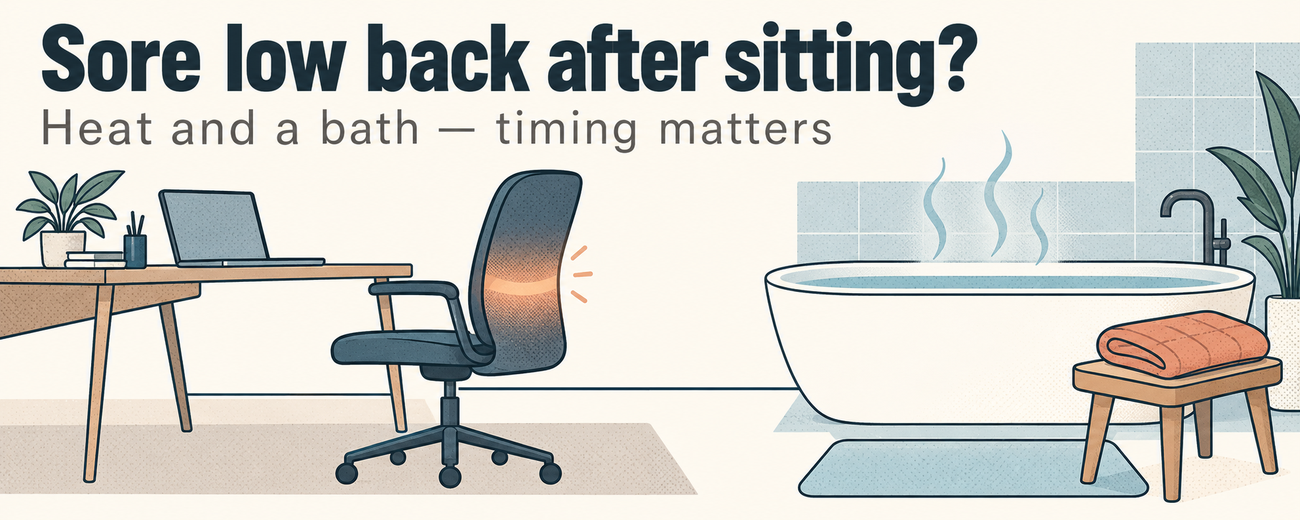
After a day at a desk or a long stretch in front of a screen, that dull ache across the low back is a familiar part of the day. Some people take a bath in the evening, some stick a heat patch on the lower back, some do both. Bath first and then heat, or the other way round? Walk around after the heat, or apply heat after the walk? On the question of when these things belong, what has the research actually found?
This article starts from the existing evidence: what superficial heat does for a sore low back, how heat and a bath fit into one day, and when to see someone instead.
Sitting, posture and a sore low back
Hold one sitting position long enough and the back muscles stay loaded without moving. Given time, that reads as tightness and as ache. Beyond sitting, standing posture, poor sitting posture, long periods on your feet and bending to lift are all commonly blamed for a sore low back.
In 2020, an Australian and German research team published an "umbrella review" in the Journal of Biomechanics, pulling together 41 systematic reviewsNote 2. Associations are there to be found: sitting for long stretches, standing for long stretches, bending and twisting, poor posture — all of them show links to low back pain. Whether those factors cause low back pain is something the reviews have not reached consensus on.
Put differently: posture and sitting often show up alongside a sore back, and fixing your chair position and getting up on a timer are both worth doing — but a sore low back is usually several things stacked together, and "sit up straight" on its own will not necessarily settle it.
The medical literature calls this non-specific low back pain: pain or discomfort in the low back with no clear structural cause identified. Most desk-bound soreness sits in that category, and the heat-therapy studies cited here were all run in adults of exactly that kind.
What heat does for a sore low back
What the clinical guideline says: American College of Physicians, 2017
In 2017 the American College of Physicians published its guideline on noninvasive treatments for low back pain in the Annals of Internal MedicineNote 1. It opens with a reminder: most low back pain that has lasted under three months improves over time regardless of what you do. On that basis, superficial heat is a first-choice non-drug option (moderate-quality evidence), with massage, acupuncture and spinal manipulation also worth considering (low-quality evidence). This is graded a strong recommendation.
The fullest account we have: the 2006 Cochrane review
"Superficial heat or cold for low back pain", published in 2006 by French SD and colleagues in the Cochrane Database of Systematic Reviews, remains the most complete systematic review on the questionNote 3.
It included 9 trials — randomised and non-randomised controlled trials — covering 1,117 adults in total. The headline results:
Heat wrap vs oral placebo (2 trials, 258 people, low back pain of under three months)
- After five consecutive days, the heat-wrap group's pain relief score (0–5, higher is better) averaged 1.06 points above the placebo group (95% confidence interval 0.68–1.45) — a statistically significant gap.
Heat wrap plus exercise (1 trial, 100 people)
- Adding exercise on top of the heat wrap produced lower pain on day 7 than the heat wrap alone.
Immediate effect of a heated blanket (1 trial, 90 people, low back pain of recent onset)
- Measured immediately after use, pain scores (0–100) averaged 32.20 points lower (95% confidence interval 25.71–38.69).
Cold: too few usable trials to draw a conclusion. On whether heat or cold is better, the existing studies do not agree.
The authors' overall verdict: the evidence base supporting superficial heat is limited and more high-quality randomised trials are needed. On the evidence available — graded moderate — a heat wrap produces a small short-term reduction in pain and disability.
Why heat might help: the Freiwald review
"A role for superficial heat therapy in the management of non-specific, mild-to-moderate low back pain in current clinical practice: a narrative review", published in 2021 by Freiwald J and seven co-authors in Life, gathers the reasons heat may help a sore low backNote 4.
Their conclusion: continuous low-level heat therapy is associated with pain relief, improved muscle strength and greater flexibility. The main mechanism is that heat raises local tissue temperature, which increases blood flow and lowers muscle tension. The review also files heat wraps and hot water bottles (conduction) alongside baths (convection) as different forms of the same superficial heat.
This is a narrative review, and its value is in explaining mechanism. For effect sizes, the Cochrane numbers above are the ones to read.
Timing: heat before movement, after movement, or before bed
In French et al. (2006), the heat-plus-exercise trial ran heat and exercise over the same period; the study did not compare "heat then move" against "move then heat" to see which order works better. So the arrangement below is reasoning from mechanism and everyday experience, not a tested result:
| Timing | The possible reasoning | Worth watching |
|---|---|---|
| Heat before moving | With tissue temperature up, muscles feel less stiff, so stretching or walking goes more easily | Long spells of heat on one spot carry a low-temperature burn risk; the adverse effects recorded in the Cochrane review were mostly brief skin redness |
| Heat after moving | Heat after a walk or a stretch eases the tightness at the end of the day | If a knock or a sprain has just happened, hold off on heat |
| A bath before bed | Shedding heat after the bath helps you drop off — but that belongs to sleep, a separate matter from a sore back | Water too hot or too long in it makes it harder for the body to cool down |
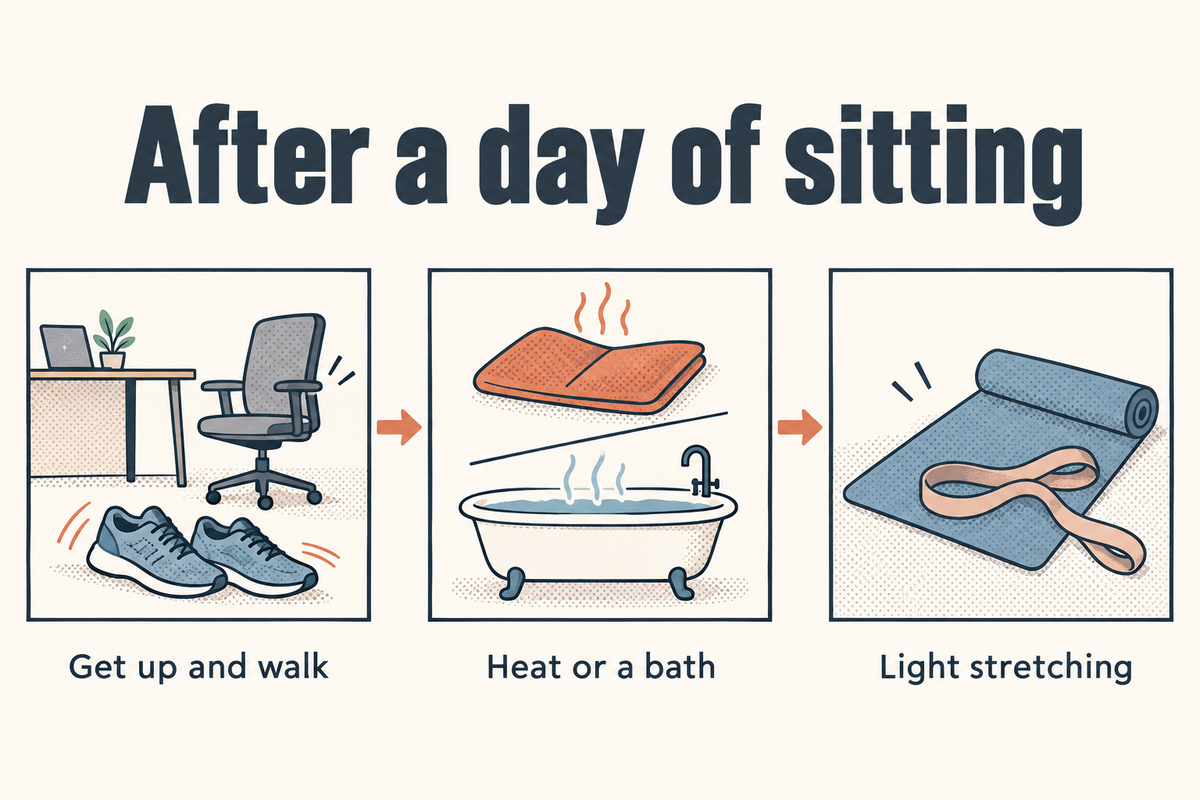
Take "low back sore and heavy after a whole day sitting". The more sensible order is:
Get up and walk for a few minutes → heat or a bath → light stretching
The point is to get the body moving first — not to sit down, slap on a heat patch and then lie still for a long stretch.
For self-care during working hours, see our Does Heat Help Neck and Shoulder Pain? Where Movement, Strength Training, Local Heat and a Bath Each Belong|DaFang 1956 — the research and the routines in it apply to the low back just as well.
A bath and a local heat pack: what actually differs
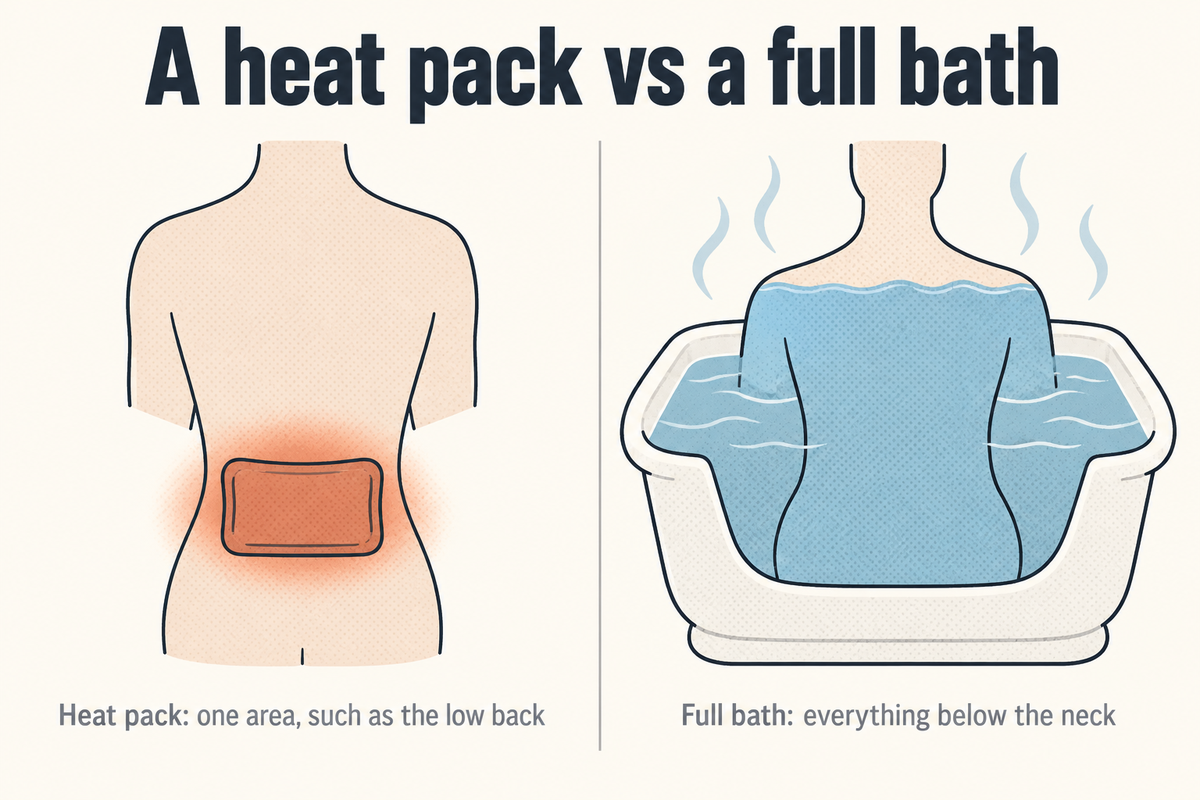
Local heat (heat wraps, heat patches, heating pads) and a full-body bath are both superficial heat, but they differ on a few axes:
| Axis | Local heat (wrap / patch / pad) | Full-body bath |
|---|---|---|
| Coverage | One area, such as the low back | Everything below the neck |
| Temperature control | Fixed by product design, easy to hold steady | Down to a thermometer or your hand — harder to get precise |
| Flexibility | Can stay on while you work, for long stretches | Needs a tub; fixed and shorter in duration |
| Research on a sore low back | Trials exist (French 2006) | Little research aimed at the low back |
For a sore low back after sitting, local heat has the more concrete research behind it (though the trial count is still small). Direct trials of a bath for a sore low back are scarce, and most of what is said about it reasons from the mechanism of heat.
If you already bathe regularly, Japan's Consumer Affairs Agency offers the reference points for temperature and time: water below 41°C, about 10 minutes, and get up slowly. Older people and anyone with cardiovascular disease should be more careful still. For the detail, see our Is a hot spring better than a hot bath? Heat, water pressure and buoyancy, and what the balneotherapy evidence really shows.
DaFang 1956's Beitou white sulphur hot spring powder is concentrated from the white sulphur springs of Sulphur Valley and keeps the natural spring-flower crystals intact, with no fragrance, no colourants and no chemical additives. Bathing at home, the principles for temperature and time are the same as any other bath: comfortable rather than scalding, and don't stretch it out. There is no need to push the water hotter to "feel more"Note 5.
When to see a professional first
If any of the following show up, get the cause checked rather than waiting it out with heat and baths:
- A sore low back that has gone weeks without improving
- Pain at night, trouble getting to sleep, pain more pronounced lying flat
- Numbness, pins and needles or weakness in one or both legs
- Any change in bladder or bowel control
- A recent injury or fall, or a history of something like osteoporosis
- Rapid weight loss or unexplained fever alongside it
These warning signs need specific causes ruled out first. Superficial heat is not the right first step in any of them.
Medical boundary
The studies cited here were run in adults with non-specific low back soreness; the conclusions do not carry over to cases with a specific cause or diagnosis. This article is a summary of research. It is not individual medical advice and does not replace assessment by a doctor or a physiotherapist.
FAQ
Q1: Heat or cold — which is more useful for a sore low back?
In the Cochrane review by French et al. (2006), heat has trial numbers you can look at; cold had too few trials to support a conclusion, and comparisons between the two came out inconsistent. For low back pain of under three months, heat currently has the fuller research base, and the American College of Physicians guideline lists it as a first option. What cold lacks is trials — the research has not shown it to be ineffective.
Q2: How long should a heat wrap stay on?
In the heat-wrap trials gathered by Freiwald et al. (2021), a common design was a low-level wrap at around 40°C worn 8 hours a day; the main result in French et al. (2006) was measured after five consecutive days of use. Those are the protocols the trials used, not a recommended number of hours for everyone. In practice, follow the product instructions and keep an eye on your skin to avoid a low-temperature burn.
Q3: How hot does a bath need to be?
There is no direct trial of "sore low back × bath water temperature". The general safety advice is water below 41°C for about 10 minutes (Japan's Consumer Affairs Agency). The Japanese crossover trial cited in our Does Heat Help Neck and Shoulder Pain? Where Movement, Strength Training, Local Heat and a Bath Each Belong|DaFang 1956 also used full-body immersion at 40°C for 10 minutes a day.
Q4: After sitting all day, heat straight away or move around first?
No trial compares those two orders directly. Get up and move your body first. Walk around before applying heat and the body has already warmed up a little; if it is only mild soreness, light stretching while the heat is on works too. There is one principle: heat alongside movement — don't let heat replace moving.
Further reading
- Does Heat Help Neck and Shoulder Pain? Where Movement, Strength Training, Local Heat and a Bath Each Belong|DaFang 1956
- How Long After Exercise Can You Take a Hot Bath? Check 3 Body Signals First|DaFang 1956
- Is a hot spring better than a hot bath? Heat, water pressure and buoyancy, and what the balneotherapy evidence really shows
Sources
-
Qaseem, A., Wilt, T. J., McLean, R. M., & Forciea, M. A. (2017). Noninvasive treatments for acute, subacute, and chronic low back pain: A clinical practice guideline from the American College of Physicians. Annals of Internal Medicine, 166(7), 514–530. https://doi.org/10.7326/M16-2367
-
Swain, C. T. V., Pan, F., Owen, P. J., Schmidt, H., & Belavy, D. L. (2020). No consensus on causality of spine postures or physical exposure and low back pain: A systematic review of systematic reviews. Journal of Biomechanics, 102, 109312. https://doi.org/10.1016/j.jbiomech.2019.08.006
-
French, S. D., Cameron, M., Walker, B. F., Reggars, J. W., & Esterman, A. J. (2006). Superficial heat or cold for low back pain. Cochrane Database of Systematic Reviews, (1), CD004750. https://doi.org/10.1002/14651858.CD004750.pub2
-
Freiwald, J., Magni, A., Fanlo-Mazas, P., Paulino, E., Sequeira de Medeiros, L., Moretti, B., Schleip, R., & Solarino, G. (2021). A role for superficial heat therapy in the management of non-specific, mild-to-moderate low back pain in current clinical practice: A narrative review. Life, 11(8), 780. https://doi.org/10.3390/life11080780
Guidelines and official data (not research evidence, listed separately)
- Bathing safety advice from Japan's Consumer Affairs Agency (water below 41°C, about 10 minutes), cited as in our "Is a hot spring better than a hot bath?" article.
Notes
Note 1 "Acute and subacute" low back pain in the ACP guideline together covers roughly the first 12 weeks (3 months); this article renders that in plain language as "under three months". The guideline's recommendations rest on randomised controlled trials and systematic reviews up to April 2015, with the search updated to November 2016.
Note 2 Swain et al. (2020) is an umbrella review of systematic reviews, taking in 41 of them. Meta-analyses supported an association fairly consistently; reviews restricted to prospective studies were less consistent. The authors' conclusion is that the association is on record but causality cannot be established from it.
Note 3 The 9 trials in the review compared different interventions (heat wraps, heated blankets, cold packs and others), so they could not all be pooled; the numbers above come from individual comparisons. The review was published in 2006 — bear the date in mind when reading the figures.
Note 4 Disclosure: medical writing assistance for that paper was funded by Angelini Pharma. The first author, Freiwald, served on a Pfizer advisory board until 2018, and two other authors disclosed consulting or speaking fees from Angelini and other pharmaceutical companies.
Note 5 The brand paragraph describes general principles of temperature and duration only. It makes no claim about mineral efficacy or therapeutic effect; "white sulphur" describes the character of the Beitou spring and does not stand for any specific health effect.